



Tungsten-nickel-copper (W-Ni-Cu) alloys
Tungsten-nickel-copper (W-Ni-Cu) alloys are based on tungsten, with the addition of small amounts of nickel, copper, and other alloying elements. They are characterized by being non-magnetic, possessing a high and adjustable density, offering superior high-energy radiation shielding (with a radiation absorption coefficient one-third higher than that of lead), exhibiting a low coefficient of thermal expansion (4–6 × 10⁻⁶/°C), and being both machinable and weldable. These alloys are widely used in applications such as radiation shielding in environments sensitive to magnetic interference.
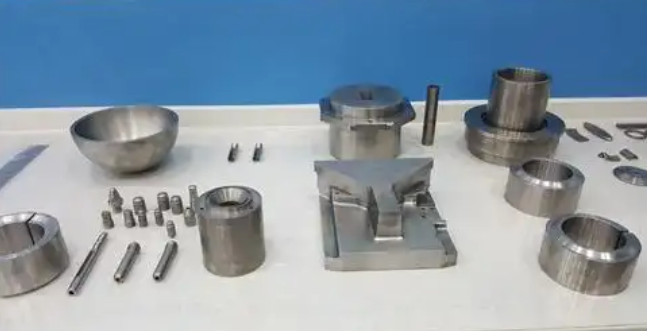
a. High specific gravity: Typically ranges from 16.5 to 18.75 g/cm³.
b. High strength: Tensile strength ranges from 700 to 1000 MPa.
c. High thermal conductivity: Approximately five times that of mold steel.
d. Low coefficient of thermal expansion: Only 1/2 to 1/3 that of iron or steel; also features good electrical conductivity, weldability, and machinability.
Material Properties:
Tungsten-based high-density alloys primarily leverage the high density and radiation-shielding capabilities of tungsten. W-Ni-Cu alloys are also used as electrode materials. In the medical and nuclear industries, they serve as shielding materials. Specialized applications include cores and projectiles for armor-piercing ammunition. In the aerospace industry (compliant with DFARS regulations), they are used for components such as turbine blades, propellers, inertial systems, fluid control systems, bucking bars (for riveting), counterweights, ballast weights, vibration-damping (stabilizing) materials, helicopter rotor blade counterweights, instrument components, missile parts, vibration-dampening elements, specialized machinery, and prototypes (e.g., for stamping or cold-heading dies).
For high-density alloys, smaller components can achieve higher densities, which generally correlates with superior mechanical properties. Larger components currently exhibit slightly lower performance metrics, though manufacturing processes are continuously being improved. Dehydrogenation treatment can significantly enhance the elongation of the alloy.
Typically, key parameters of interest to customers include density, elongation, and tensile strength; requirements may also extend to the elastic modulus, coefficient of thermal expansion, thermal conductivity, and grain size. The most common requirements pertain to tensile strength and elongation; dehydrogenation treatment significantly improves the elongation of the alloy.
Typically, the average tungsten grain size in as-sintered high-density alloys ranges from 30 to 60 microns.
Applicable standards: 1. GB/T 26038—2010 and ASTM B 777-99
Properties of the W-Ni-Cu alloy system
| Grade | Density | Hardness | Modulus of Elasticity | Elongation | Tensile Strength | Coefficient of Thermal Expansion | Thermal Conductivity |
| g/cm³ | HRC | GPa | % | MPa | 10⁻⁶/K | W/(m·K) | |
| W96Ni2Cu2 | 17.9-18.1 | 25-33 | – | 2-4 | 500-600 | – | – |
| W95Ni3.5Cu1.5 | 17.7-17.9 | 25-32 | 350 | 3-5 | 500-700 | – | – |
| W95Ni3Cu2 | 17.8-18.0 | 25-30 | – | 4-7 | 500-700 | – | – |
| W93Ni4Cu3 | 17.5-17.7 | 18-24 | – | 5-10 | 550-700 | – | – |
| W93Ni4.9Cu2.1 | 17.5-17.6 | 20-25 | – | 5-8 | 550-750 | – | – |
| W90Ni7Cu3 | 17.0-17.2 | 20-26 | – | 8-12 | 550-800 | – | – |
| W90Ni6Cu4 | 17.0-17.2 | 18-23 | – | 8-16 | 550-750 | – | – |