



Tungsten-Nickel-Iron Alloy
Tungsten-nickel-iron alloys are characterized by high sintered density, good strength and ductility, and a degree of ferromagnetism. They exhibit excellent plasticity, machinability, thermal and electrical conductivity, and superior absorption capacity for gamma (γ) rays and X-rays.
High specific gravity: Typically 16.5–18.75 g/cm³.
High strength: Tensile strength ranges from 700 to 1000 MPa.
Strong radiation absorption: 30–40% higher than that of lead.
High thermal conductivity: Approximately 5 times that of mold steel.
Low coefficient of thermal expansion: Only 1/2 to 1/3 that of iron or steel.
Good electrical conductivity: Widely used in the lighting and electric welding industries due to this property.
Good weldability and machinability.
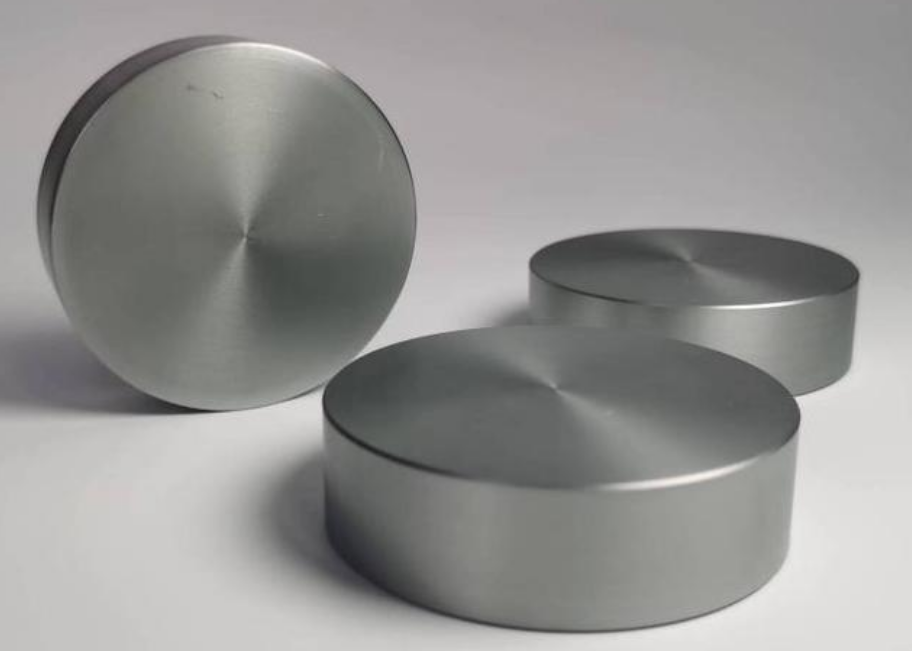
Applications:
Tungsten-nickel-iron alloys have a very wide range of applications and have become the most extensively used type of tungsten-based heavy alloy. For general purposes—such as counterweights, balancing weights, and radiation shielding—the sintered alloy is used directly. However, for applications requiring high mechanical performance, the alloy undergoes deformation processing (such as forging or rolling) and heat treatment to achieve greater strength.
Tungsten-nickel-iron alloys are primarily used to manufacture components for aerospace and aviation, including gyroscope rotors, guidance systems, and vibration-damping devices. They are also used in mechanical manufacturing for die-casting molds, tool holders, boring bars, and automatic watch rotors. In the defense sector, they serve as cores for armor-piercing projectiles, while in electrical engineering, they are used for rivet heads and switch contacts. Additionally, they are employed in the production of various radiation-shielding components.
Generally, customers focus on parameters such as density, elongation, and tensile strength; requirements for elastic modulus, coefficient of thermal expansion, thermal conductivity, and grain size are also occasionally specified. Tensile strength and elongation are the most common requirements, and a dehydrogenation treatment can significantly improve the elongation of the alloy.
Typically, the average tungsten grain size of high-density alloys in the as-sintered state ranges from 30 to 60 microns.
| Tungsten-Nickel-Iron Alloy | ||||
| Type | Density (g/cm3) |
Tensile Strength Mpa |
Elongation (%) |
Hardness (HRC) |
| 85W-10.5Ni-4.5fe | 15.8~16.0 | 700~980 | 20~33 | 20~28 |
| 90W-7Ni-3fe | 16.9~17.15 | 700~980 | 20~33 | 24~32 |
| 90W-6Ni-4fe | 16.8~17.0 | 700~980 | 20~33 | 24~32 |
| 91W-6Ni-3fe | 17.1~17.3 | 700~980 | 16~25 | 25~32 |
| 92W-5Ni-3fe | 17.3~17.5 | 700~980 | 18~24 | 25~32 |
| 92.5W-5Ni-2.5fe | 17.4~17.6 | 700~980 | 24~30 | 25~32 |
| 93W-4Ni-3fe | 17.5~17.6 | 700~980 | 15~25 | 26~30 |
| 93W-4.9Ni-2.1fe | 17.5~17.6 | 700~980 | 18~28 | 26~30 |
| 93W-5Ni-2fe | 17.5~17.6 | 700~980 | 15~25 | 26~30 |
| 95W-3Ni-2fe | 17.9~18.1 | 600~750 | 8~15 | 28~35 |
| 95W-3.5Ni-1.5fe | 17.9~18.1 | 600~750 | 8~13 | 28~35 |
| 96W-3Ni-1fe | 18.2~18.3 | 600~750 | 6~10 | 30~35 |
| 97W-2Ni-1fe | 18.4~18.6 | 550~750 | 8~14 | 30~35 |
| 98W-2Ni-1fe | 18.5~18.7 | 550~750 | 2~5 | 30~36 |
| Type | Length(mm) | Width(mm) | Height(mm) | Diameter(mm) |
| Plate | 10~600 | 10~300 | 2~200 | - |
| Bar | 2~600 | - | - | 2~320 |
| Customized | Per customer requirements, unit weight < 500 kg | |||