



Molybdenum Copper Alloy (MoCu Alloy) Heat Sink
Molybdenum Copper Alloy (MoCu Alloy)
The Advanced Composite for Precision Thermal Management and Electronic Packaging: Unlocking Performance and Reliability
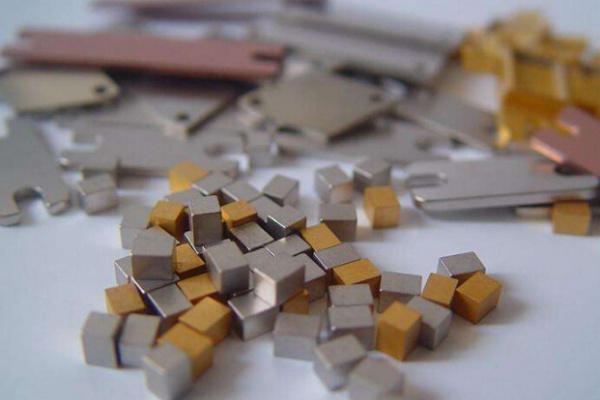
Molybdenum Copper Alloy (MoCu) is a sophisticated composite material strategically designed to combine the low coefficient of thermal expansion (CTE) and high stiffness of molybdenum with the exceptional thermal and electrical conductivity of copper. This unique pseudo-alloy, typically fabricated through powder metallurgy techniques involving the infiltration of a porous molybdenum preform with copper, delivers an unparalleled solution for advanced thermal management and electronic packaging challenges. MoCu alloys are engineered to effectively dissipate intense heat while precisely matching the CTE of silicon (Si), gallium arsenide (GaAs), and other semiconductor materials, thereby preventing thermal stress and ensuring long-term reliability in high-power, high-frequency, and optoelectronic applications. By offering a customizable balance of these critical properties, Molybdenum Copper Alloys enable the creation of more compact, powerful, and dependable electronic devices in the most demanding environments.
- Product Details
Molybdenum Copper Alloy is distinguished by a powerful and highly controllable combination of characteristics:
Exceptional Thermal Conductivity: Leverages copper’s inherent high thermal conductivity (ranging from 160-250 W/m·K depending on composition), ensuring rapid and efficient heat dissipation away from heat-sensitive components.
Low & Customizable Coefficient of Thermal Expansion (CTE): Molybdenum provides a critically low CTE (down to 6-9 ppm/°C). The specific Mo:Cu ratio can be precisely tailored to closely match the CTE of various semiconductor materials (like Si or GaAs), eliminating thermal stress-induced failures in high-power electronic devices.
High Electrical Conductivity: Retains excellent electrical conductivity (typically 50-70% IACS), making it an ideal substrate and packaging material for high-current applications.
High Stiffness & Dimensional Stability: Molybdenum contributes significant stiffness and prevents warping or deformation, particularly under fluctuating thermal loads, ensuring the long-term integrity of complex assemblies.
Good Machinability: Despite its high strength, MoCu alloys offer good machinability (especially compared to pure molybdenum), allowing for the production of intricate shapes and precise dimensions required in advanced electronics.
Hermeticity & Vacuum Integrity: Its dense, non-porous microstructure, achieved through liquid phase sintering or infiltration, ensures excellent hermetic sealing capabilities and low outgassing rates, crucial for vacuum tubes and other hermetically sealed electronic packages.
Controlled Density: The density of the alloy can be varied based on the molybdenum-to-copper ratio, typically ranging from 10.0 to 14.5 g/cm³.
Non-Magnetic Properties: Inherently non-magnetic, which is essential for certain electronic and medical applications where magnetic interference must be avoided.
High Temperature Performance: Maintains structural integrity and thermal properties at elevated operating temperatures, superior to pure copper or aluminum.
Corrosion Resistance (Specific Applications): While not the primary function, it offers reasonable resistance in certain non-oxidizing environments.
- Applications
Molybdenum Copper Alloy is a cornerstone material in high-performance electronics and other critical industries requiring advanced thermal and electrical management:
Thermal Management in High-Power Electronics:
Heat Sinks & Heat Spreaders: For high-power integrated circuits (ICs), CPUs, GPUs, LED arrays, and laser diodes, where efficient heat transfer and CTE matching are critical.
Substrates for Power Modules: Used in Insulated Gate Bipolar Transistors (IGBTs), RF power devices, and other high-power semiconductor packages to ensure thermal stability and reliability.
Optoelectronics & Laser Technology:
Laser Diode Mounts & Substrates: Provides precise thermal control and alignment stability for sensitive laser components.
Optical Windows & Housings: In high-power laser systems where thermal expansion must be minimized.
Electrical Contacts & Electrodes:
Resistance Welding Electrodes: Exhibits excellent resistance to deformation and good electrical conductivity, leading to longer electrode life.
Electrical Discharge Machining (EDM) Electrodes: Used for precision machining due to its excellent electrical conductivity and wear resistance.
High-Current Breakers & Switches: For contact materials requiring wear resistance and high conductivity.
Microwave & RF Devices:
Waveguides & RF Transistor Bases: Providing necessary thermal pathways and dimensional stability in high-frequency applications.
Telecommunications Components: For active and passive components requiring stable electrical and thermal performance.
Aerospace & Defense:
Thermal Control Substrates: In sensitive avionics, satellite components, and guidance systems for weight-optimized thermal solutions.
Vacuum Tube Components: Grids, anodes, and other internal structures where high temperatures and vacuum integrity are crucial.
Medical Equipment: In certain high-stability electronic subassemblies for diagnostic and therapeutic devices.