

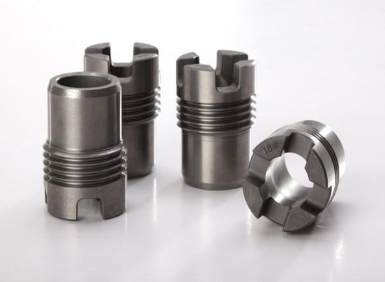
Cemented carbide nozzles are precision spray components made using tungsten carbide powder (WC powder) as the hard phase and cobalt or nickel as the binder phase, manufactured through powder metallurgy. They exhibit excellent comprehensive performance in high-temperature, high-speed erosion, and highly corrosive environments, making them the most widely used high-end material in the industrial nozzle field.
I. Physicochemical Properties of Cemented Carbide Nozzles
FOTMA ALLOY cemented carbide nozzles offer excellent comprehensive performance, combining outstanding mechanical and environmental adaptability. Their outstanding hardness and wear resistance allow them to maintain structural stability under complex working conditions for extended periods, effectively extending their service life. They also exhibit good hot hardness and thermal shock resistance, withstanding significant temperature changes and making them suitable for high-temperature operating environments. It possesses reliable corrosion resistance, adapts to various complex media environments, exhibits strong dimensional stability, and shows only slight performance degradation after long-term use. Furthermore, the material is environmentally friendly and non-toxic, containing no harmful components, meeting the requirements of green applications and having a wide range of applications.
II. Classification of Carbide Nozzles
The classification system for carbide nozzles covers eight key dimensions: binder phase, WC grain size, binder phase content, second phase addition, structural form, surface treatment, connection method, and precision level. Each dimension is further subdivided into several typical categories, clearly defining the performance characteristics of different specifications. For example, cobalt-based binder phase nozzles offer high cost-effectiveness, and submicron grain size products exhibit excellent wear resistance. It also matches suitable application scenarios; for instance, venturi-type structures are suitable for sandblasting, HVOF, and other supersonic applications, while ultra-precision levels meet the high-requirement requirements of waterjet cutting, semiconductor wet etching, and other applications.
Carbide nozzles are one of the important tools for machining metallic or non-metallic materials. Depending on different application requirements and technical characteristics, various types of cemented carbide nozzles are available:
1. Straight-hole type: Standard nozzles suitable for ordinary drilling and milling processes;
2. Conical nozzle: Features long service life and high precision, suitable for precision manufacturing;
3. Hollow spherical nozzle: Offers good wear resistance and corrosion resistance, particularly suitable for use under high temperature and high pressure conditions in harsh environments. In addition, there are composite nozzles and other types available to choose from depending on specific working conditions.
III. Production Method of Cemented Carbide Nozzles
The production method of cemented carbide nozzles is mainly based on powder metallurgy. Its steps include (1) raw material preparation, (2) forming, (3) sintering, (4) finishing, and (5) inspection.
In the raw material preparation stage, tungsten carbide powder and cobalt/nickel binder powder are weighed according to a preset ratio. Using an organic solvent as a medium, they are wet-milled in a ball mill until the tungsten carbide particles are uniformly coated, forming a stable composite powder. This powder is then spray-dried to produce free-flowing granular powder suitable for subsequent forming.
The forming stage is a crucial step in transforming powder into a near-net-shape blank. Common methods include cold isostatic pressing (COP) and injection molding. COP utilizes a liquid medium to apply uniform pressure, densifying the powder in a flexible mold to form a blank with a uniform density distribution. Injection molding involves first mixing the powder with an organic binder to create a flowable slurry, which is then injected into a precision mold for curing and demolding.
Sintering is the core process. High-temperature treatment under a vacuum or hydrogen protective atmosphere melts the binder phase and wets the tungsten carbide particles, achieving liquid-phase densification. The process is divided into pre-sintering and main sintering: pre-sintering slowly removes organic matter to prevent cracking of the blank; main sintering controls the temperature gradient to promote particle rearrangement and pore closure, forming a hard alloy body with near-theoretical density. After sintering, the blank needs to be slowly cooled to release internal stress.
The finishing stage involves precision grinding and polishing of the sintered body. Diamond tools are used in CNC machine tools to machine the flow channels, throats, and outer shape, resulting in a mirror-like finish on the internal surfaces. Surface treatment options include boronizing or diamond-like carbon coating to further enhance corrosion resistance and friction reduction.
Final inspection includes dimensional measurement, hardness testing, and pressure resistance testing to ensure each nozzle meets industry standards.
IV. Comparison of Carbide Nozzles with Other Nozzles
Compared to sapphire, ruby, engineering ceramics, stainless steel, and copper alloys, nozzles made of carbide offer superior overall performance. They excel in density, room temperature hardness, high-temperature strength retention, wear resistance, cavitation resistance, high-temperature stability, and cost-effectiveness, making them suitable for numerous applications. However, they suffer from near-irreparable defects. Sapphire and ruby offer outstanding hardness and corrosion resistance but suffer from low impact toughness and are irreparable. Engineering ceramics are repairable but have weak high-temperature performance. Stainless steel and copper alloys are easy to process and maintain but have shortcomings in core properties such as wear resistance and high-temperature resistance, limiting their application scenarios.
V. Applications of Carbide Nozzles
Carbide nozzles are used in core operating conditions across multiple industries, including high-pressure water jet cutting, coal chemical gasification, semiconductor cleaning, and 3D printing powder feeding. Its key advantages lie in its adaptability to extreme environments: stable orifice diameter under ultra-high pressure, long service life under supersonic particle erosion, and continuous service under high-temperature and corrosive conditions. It also possesses environmentally friendly, anti-adhesion, and stable flow angle characteristics.
Oil and Gas Applications: Carbide nozzles are mainly used for cooling spray and mud flushing during drill bit operation. The appropriate nozzle (orifice diameter and shape) is selected based on the operating environment.
Tubular nozzles are mainly used in roller cone drill bits.
Threaded nozzles are mainly used in PDC drill bits.
Non-standard Wear-resistant Parts for Drilling and Cementing Systems: Carbide custom-shaped wear-resistant parts are widely used in oil drilling, cementing, and well workover systems. These products feature complex geometries, high precision, good wear resistance and corrosion resistance, with dimensional and positional accuracy grades of IT5~IT7 and surface roughness Ra0.8~0.1.
We can design and manufacture materials and structures according to user requirements. Contact us now to get a quote!
Post time: Mar-09-2026