

Heat sink materials are used to absorb and dissipate heat. Their main function is to transfer heat from heat-generating components to a larger heat dissipation surface, thereby reducing the temperature of the heat-generating components and ensuring the normal operation of the equipment. These materials typically have high thermal conductivity, enabling them to rapidly conduct heat from the heat source to the heat sink or other heat dissipation equipment.
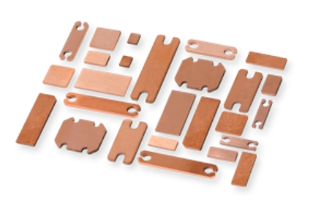
CPC Multilayer Heat Sinks: Multilayer heat sinks generally refer to composite materials with a sandwich structure, using oxygen-free copper as the surface material and molybdenum or molybdenum-copper alloy as the middle layer. They combine the high thermal conductivity of copper with the low coefficient of thermal expansion of molybdenum, and the coefficient of thermal expansion is adjustable.
CPC (copper/molybdenum copper/copper) multilayer metal heat sink material is a composite material specifically designed for the microelectronics packaging field. Its unique sandwich structure and high-performance characteristics make it a leader in thermal management solutions.
CPC material consists of three layers: the middle layer is a molybdenum-copper alloy (MoCu), and the two outer layers are pure copper (Cu).
Key advantages and characteristics of CPC multilayer heat sink materials:
1. High thermal conductivity:
CPC heat sink materials possess high thermal conductivity; for example, CPC232 has a thermal conductivity of 350 W/(M·K) (data source: Huazhi New Materials official website). This means it can quickly and effectively dissipate heat from the heat source, preventing damage to electronic devices due to overheating.
2. Low coefficient of thermal expansion:
CPC heat sink materials have a low coefficient of thermal expansion, which can be adjusted as needed. This characteristic allows for good thermal matching with ceramic and semiconductor materials, reducing dimensional changes and stress caused by temperature variations.
3. Designable coefficient of thermal expansion:
The coefficient of thermal expansion of CPC heat sink materials is designable. By adjusting the ratio of molybdenum-copper alloy to pure copper, it can be customized according to different application scenarios and requirements. This flexibility allows CPC heat sink materials to adapt to various complex electronic packaging requirements.
4. High-temperature resistance:
CPC heat sink materials can withstand high-temperature environments, with a strong interfacial bond, and can repeatedly withstand high-temperature shocks.
5. High Strength and Excellent Mechanical Properties:
CPC heat sink materials possess high strength and excellent mechanical properties, enabling them to withstand various mechanical stresses. This allows them to maintain stable performance in complex working environments.
6. Non-Magnetic:
CPC heat sink materials are non-magnetic, making them suitable for magnetically sensitive electronic devices and applications.
7. Good Processing Performance:
CPC materials can be processed through rolling, electroplating, and explosive forming to create products of various shapes and specifications, meeting diverse electronic packaging requirements.
Applications of CPC Composite Heat Sink Materials in Chip Packaging
Packaging Substrate: Due to its high thermal conductivity (e.g., a thermal conductivity TC value of up to 350 W/m·K), CPC materials are commonly used as packaging substrates in chip packaging, effectively conducting away the heat generated by the chip and reducing its operating temperature.
CPC used in ACP packaging substrates
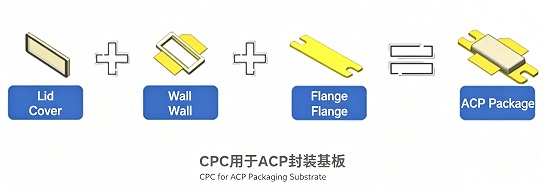
Packaging Wall Matching: CPC materials have an adjustable coefficient of thermal expansion, which can be designed to be similar to the coefficient of expansion of the chip and ceramic substrate, thereby avoiding packaging failure caused by thermal stress and making the packaging structure more stable and reliable.
Multilayer Printed Circuit Board (PCB) Thermal Conductive Channels: CPC materials can also serve as thermal conductive channels in multilayer printed circuit boards, ensuring the stability and reliability of the circuit board.
CPC used as a heat sink carrier for SMD devices (yellow area)
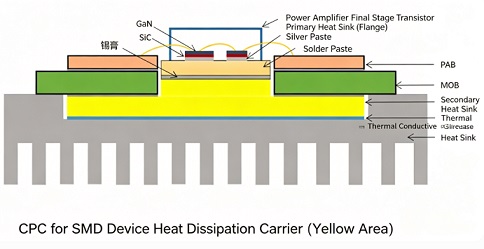
With the continuous development of microelectronics technology, the requirements for packaging materials are becoming increasingly stringent. CPC multilayer metal heat sink materials, with their excellent performance characteristics and wide range of applications, are gradually becoming one of the important materials in the microelectronics packaging field. In the future, with the continuous advancement of manufacturing technology and the emergence of new materials, the application of CPC materials in the field of thermal management will become even more widespread.
FOTMA ALLOY, as a leading manufacturer of CPC multilayer heat sink materials, holds a leading position in the field of multilayer metal heat sinks, and its CPC multilayer metal heat sinks are in stable mass production. They are highly praised for their products’ excellent high thermal conductivity and adjustable coefficient of thermal expansion.
Post time: May-08-2026