

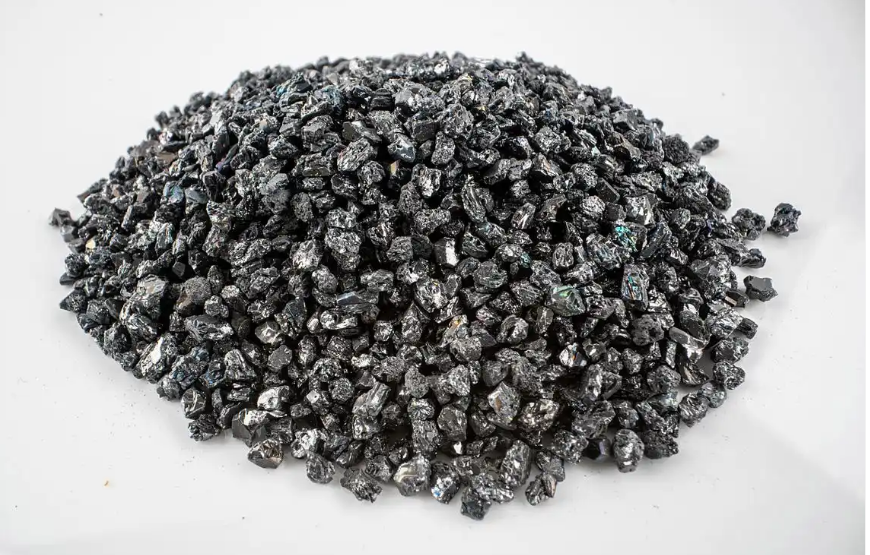
Tungsten carbide (WC) is a superhard compound composed of tungsten and carbon. Due to its excellent wear resistance, high hardness, and corrosion resistance, it has become one of the most important wear-resistant materials in industrial fields. The following is a detailed analysis of its properties, applications, preparation, market, and cutting-edge developments:
I. Core Characteristics and Structure
Physical Properties: Tungsten carbide has a typical hexagonal crystal structure, with a microhardness as high as 17,300 MPa (approximately Mohs hardness 9, second only to diamond), an elastic modulus of 710 GPa, a density of 15.63 g/cm³, and a melting point of 2870°C. Its high hardness originates from the strong covalent bonds between tungsten and carbon atoms, while its metallic luster and electrical conductivity reflect its metallic bonding characteristics.
Chemical Stability: Tungsten carbide is insoluble in water, hydrochloric acid, and sulfuric acid at room temperature, but readily soluble in a mixture of nitric acid and hydrofluoric acid. At high temperatures (>500°C), its oxidation resistance is weak, requiring coatings or alloying to enhance corrosion resistance.
Brittleness Improvement: Pure tungsten carbide is quite brittle. By adding metals such as cobalt (Co) and nickel (Ni) as binders (typically 5-20%), cemented carbide (such as WC-Co) can be formed, significantly improving toughness. For example, a WC-Co alloy containing 10% cobalt can achieve a bending strength exceeding 2,000 MPa.
II. Application Areas and Typical Cases
Industrial Manufacturing
Cutting Tools: Carbide tools (such as end mills and drill bits) account for over 40% of tungsten carbide applications, with a lifespan 5-10 times longer than high-speed steel tools. For example, WC-TiC-Co tools are widely used in automotive parts machining.
Wear-Resistant Parts: Hammers in mining crushing equipment, sealing rings in oil drilling, and bearing balls all rely on the high wear resistance of tungsten carbide. A car manufacturer has adopted supersonic spraying of tungsten carbide coatings to repair stamping dies, nearly doubling their lifespan and reducing scratches on products by 80%.
High-end Manufacturing and New Energy
Automotive Industry: Tesla’s Cybertruck is considering using tungsten carbide coatings to enhance body wear resistance; Porsche applies tungsten carbide coatings to its braking systems to reduce wear and brake dust.
Hydrogen Energy and Catalysis: Tungsten carbide nanoparticles, used as catalysts for water electrolysis to produce hydrogen, exhibit an overpotential of only 215 mV when combined with nickel-iron layered double hydroxide (NiFe-LDH), outperforming most non-precious metal catalysts. Core-shell structured WC/W₂C composites demonstrate high activity in the electrocatalytic oxidation of methanol.
Aerospace and Defense
Tungsten carbide’s high-temperature stability (withstanding temperatures above 1,000°C) is utilized in high-temperature and wear-resistant applications such as jet engine components and missile warhead casings.
In bulletproof armor, tungsten carbide ceramic sheets combined with metal backing plates can withstand armor-piercing projectile impacts.
Consumer Goods and Jewelry
High-end consumer goods such as watch cases and pen nibs utilize tungsten carbide to enhance wear resistance.
In the jewelry industry, tungsten carbide rings are favored for their high hardness and scratch-resistant properties.
III. Manufacturing Processes and Technological Innovation
Traditional Powder Metallurgy
Raw Material Preparation: Tungsten powder (obtained by hydrogen reduction of WO₃) is mixed with carbon powder in an equimolar ratio and sintered in hydrogen at 1,400-1,700°C to generate WC. If the temperature is insufficient, intermediate phases such as W₂C will remain.
Shaping and Sintering: The mixed powder is pressed and sintered (e.g., vacuum sintering or hot isostatic pressing) to form a dense structure. For example, ultrafine WC powder (particle size < 1 μm) can be used to prepare high-precision cutting tools.
Emerging Technologies
Joule Heating Method: Highly dispersed WC nanoparticles are synthesized in situ on carbon cloth through ultrafast heating and cooling (260-290°C/s), inhibiting agglomeration and enhancing catalytic activity.
3D Printing: Selective Laser Sintering (SLS) technology can directly manufacture tungsten carbide components with complex shapes, such as turbine blades for aero-engines.
IV. Market Dynamics and Policy Impact
Global Supply and Demand
Production Structure: China is the largest producer (68,000 tons in 2024, accounting for over 60% of global production), with major companies including Xiamen Tungsten and China Tungsten High-Tech. European, American, and Japanese companies (such as Sumitomo Corporation of Japan and Kennametal of the United States) dominate the high-end market.
Demand Growth: New energy vehicles and high-end manufacturing drive demand. The global tungsten carbide market size was approximately RMB 33 billion in 2024 and is projected to exceed RMB 50 billion by 2030.
Prices and Trade
In August 2025, the price of tungsten carbide powder in China reached 465-470 yuan/kg, an increase of approximately 50% compared to the beginning of the year. This was mainly driven by export controls (China restricted tungsten exports from February 2025) and tight supply and demand.
The international market saw significant price differences between domestic and international markets. For example, the price difference between China’s FOB and Rotterdam CIF reached 80,000 yuan/ton, reflecting strong overseas restocking demand.
Policy and Sustainability
China classifies tungsten as a strategic resource, and policies support its intensive processing (such as the “7510 Action Plan for Modernization of Key Industrial Chains in Ganzhou’s Manufacturing Industry”).
Advances in recycling technology: A project using a calcination-alkali leaching process, achieving a tungsten and cobalt recovery rate exceeding 98%, and processing 3,300 tons of waste cemented carbide annually, has been put into operation.
V. Challenges and Frontier Directions
Technological Bottlenecks
Cost Control: Tungsten resources are scarce (global reserves are approximately 3.5 million tons, with China accounting for 60%), and mining consumes high energy. The price of tungsten concentrate is projected to reach 194,500 yuan/ton in 2025, driving up the cost of tungsten carbide.
Brittleness Limitations: Although alloying improves toughness, it remains prone to cracking under impact loads, necessitating the development of gradient structures or nanocomposite coatings.
Innovation Directions
Nanomaterials: Core-shell structured WC/W₂C composites enhance electrocatalytic activity; nano-WC coatings (thickness < 100 nm) are used for surface strengthening of precision instruments.
Green Manufacturing: Develop low-energy synthesis processes (such as the Joule heating method) and promote efficient recycling technologies for waste hard alloys (such as zinc melting and patented calcination-alkali leaching methods).
Multifunctional Integration: Combine tungsten carbide with sensors to achieve real-time monitoring of wear resistance, applicable to smart factory equipment maintenance.
VI. Environment and Sustainable Development
Production Impact
Traditional sintering processes are energy-intensive (approximately 10,000 kWh per ton of tungsten carbide) and generate wastewater during hydrogen reduction.
Recycling is key: Wenzhou Hongfeng in China processes 3,300 tons of waste cemented carbide annually using a zinc smelting process, reducing primary tungsten mining.
Policy Promotion
Under China’s “dual carbon” goals, tungsten carbide production is transitioning towards greener practices, such as using renewable energy for power generation and optimizing processes to reduce carbon emissions.
The EU’s new Battery Regulation requires a 70% cobalt recovery rate in batteries by 2030, indirectly promoting the recycling of cobalt-containing cemented carbides.
VII. Conclusion
Tungsten carbide, with its “king of hardness,” is irreplaceable in industry, energy, and defense. Despite facing resource scarcity and cost challenges, its innovative applications in cutting-edge fields such as new energy, catalysis, and nanotechnology are driving the industry towards high-end and green development. In the future, with technological breakthroughs and policy support, tungsten carbide is expected to play a greater role in emerging sectors such as intelligent manufacturing and the hydrogen economy.
Post time: Jun-10-2026