

The widespread adoption of M9 laminates is pushing the PCB drill bit industry to a crossroads. As a next-generation substrate reinforced with quartz electronic fabric, M9 material boasts a silica content exceeding 99% and a melting point above 1,650°C; its Mohs hardness far surpasses that of conventional fiberglass fabric. Consequently, cutting resistance and tool wear skyrocket during processing. While traditional carbide drill bits could reliably drill about 1,000 holes in M7 substrates, that figure dropped to 400–500 for M8, and with M9, a single bit often fails to last even 200 holes—representing a 70–80% reduction in lifespan. Soaring bit breakage rates, increased tool-change frequency, and plummeting production efficiency—these on-line realities are forcing downstream PCB manufacturers to make a critical choice: continue refining carbide technology or pivot to diamond-based solutions. This is not merely a contest of material properties; it determines the technological trajectory and supply chain landscape of the multi-billion-yuan PCB drill bit market.
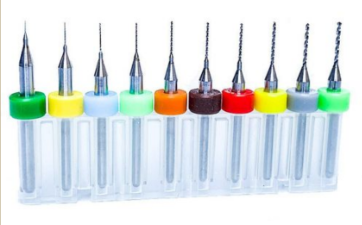
A Comparison of Technical Principles
The divergence between carbide and diamond drill bits begins with their material composition.
Carbide bits are primarily composed of tungsten carbide powder with cobalt acting as a binder, formed through powder metallurgy and sintering. Common grades like YG6X consist of 94% tungsten carbide and 6% cobalt; by refining grain sizes to the sub-micron or even nano-scale, hardness reaches HRA 88–92 (approximately 1,300–1,800 on the Vickers scale). These bits offer excellent toughness, withstanding the high-speed impacts and cutting vibrations inherent in drilling without easily suffering edge chipping. Furthermore, the manufacturing process is highly mature—spanning powder pressing, sintering, and precision grinding of spiral flutes and tip angles—resulting in a well-established supply chain where costs have been driven down significantly over the years. While the prices of raw materials like tungsten carbide and cobalt fluctuate, they remain relatively stable overall; a standard cemented carbide drill bit costs only one or two yuan.
Diamond drill bits follow a different technological path. There are two main types on the market: PCD (Polycrystalline Diamond) composites, created by sintering diamond particles and a metal binder under high temperature and pressure, then shaping them via wire-cut EDM and laser processing; and CVD (Chemical Vapor Deposition) diamonds, where a pure diamond film is grown on a substrate surface. With a hardness of HV 6000 to 10,000—making it the hardest known material in nature—diamond offers wear resistance far superior to cemented carbide. A PCD drill bit can drill 10,000 to 15,000 holes in M9-grade board while keeping its cutting edge intact—a figure dozens of times higher than that of carbide bits. However, there are clear trade-offs: while the binder phase in PCD gives it better toughness than single-crystal diamond, it still falls short of cemented carbide; CVD films are even more brittle and prone to cracking or chipping under impact loads. Due to the difficulty of processing and high manufacturing costs, a single PCD drill bit can cost between 1,500 and 2,000 yuan—hundreds of times the price of a standard carbide bit.
Ultimately, cemented carbide and diamond represent completely different choices regarding the balance of hardness, toughness, and cost. There is no absolute “better” or “worse”—only what is suitable for the specific application.
Divergent Application Scenarios
Differences in material properties translate into a clear division of use cases on the production line.
Standard FR-4 glass-fiber epoxy boards account for the majority of current PCB production. These boards have relatively low hardness and cause limited wear on drill bits, making cemented carbide bits perfectly capable of the job; drilling a thousand holes is easily achievable, offering excellent cost-effectiveness. While diamond drill bits could also handle the task, spending over a thousand yuan on a bit for a process where each hole costs mere fractions of a yuan makes no economic sense.
However, the situation reverses when dealing with high-hardness boards like M8 and M9 grades. The service life of carbide drill bits drops precipitously when processing M9 materials; a single bit can only drill 100 to 200 holes. Frequent tool changes increase production line downtime, ultimately driving up overall processing costs. Calculations indicate that the per-hole processing cost using traditional coated drill bits on M9 boards is actually higher than that of diamond drill bits. Although diamond drill bits have a higher unit price, a single bit can consistently drill 8,000 to 10,000 holes, making the cost per hole 30% to 40% lower than that of carbide bits. Data from a Shenzhen-based PCB manufacturer illustrates this clearly: once orders for M9 materials reached 30% of the total, drill bit consumption costs surged by 220% year-on-year.
At the extreme end of the spectrum—materials such as alumina and aluminum nitride ceramic substrates—carbide bits are essentially ineffective, making diamond bits the only viable solution. Flexible boards and ultra-thin boards present a different scenario; carbide bits, with their superior toughness, are less likely to crack or delaminate the material, whereas diamond bits must be used with caution due to their inherent brittleness.
Processing requirements are also driving market differentiation. Carbide bits remain dominant for standard through-holes with diameters exceeding 0.3 mm. However, for micro-vias—characterized by diameters under 0.15 mm and aspect ratios exceeding 30:1 or even 40:1—diamond drill bits offer superior edge quality and reduced burring, leading to rapidly increasing penetration in the high-end HDI board and IC packaging substrate sectors. Deep-hole drilling poses challenges for both materials, with chip evacuation serving as a common bottleneck; carbide bits can mitigate this somewhat through optimized flute geometry, while the high thermal conductivity of diamond aids heat dissipation, though the risk of bit breakage remains a constant concern.
Current Status and Trends of Industrialization
In terms of market share, carbide drill bits currently account for over 90% of the global PCB drill bit market. Key suppliers include Japan’s Union Tool and China’s Jinzhou Precision and Dingtai High-Tech; these companies have developed highly mature supply chains. In 2025, Dingtai High-Tech achieved a 29.2% market share by sales volume—ranking first globally for three consecutive years—with annual revenue and net profit growing by 35.7% and 91.1% year-on-year, respectively. In the same year, Jinzhou Precision’s net profit surged by over 105%. The combined market share of the two leading players approaches 50%, demonstrating a clear “head effect” where market leaders dominate. Prices for standard drill bits have risen from around 0.95 yuan last year to approximately 1.20 yuan—an increase of over 20%—while high-end models have seen price hikes exceeding 35%.
Diamond drill bits are currently transitioning from the validation and introduction phase to small-batch mass production. Companies such as Worldia and Sifangda have entered the validation stage with top-tier PCB manufacturers, receiving positive feedback on their product samples. In sectors demanding exceptional wear resistance—such as IC substrates and ceramic substrates—PCD (polycrystalline diamond) drill bits have already achieved a market penetration rate of 20% to 30%. Meanwhile, CVD diamond-coated drill bits remain in the small-batch trial production stage; notably, Jinzhou Precision’s nano-diamond coated bits have demonstrated a 40-fold increase in lifespan when used on M9 materials, alongside significant improvements in hole position accuracy and hole wall quality.
The trend over the next three to five years will likely be characterized by complementarity and partial substitution rather than total displacement. Carbide drill bits will not easily exit the market; they can maintain their foothold in the low-to-mid-range segments by upgrading coating technologies (e.g., AlTiN, DLC, and nano-black coatings) and optimizing substrate materials through nanocrystalline and gradient structures. Conversely, diamond drill bits will continue to penetrate the high-end market, driven by demands for processing ultra-hard materials, creating extremely small apertures, and achieving high precision. A key variable is the price trajectory of synthetic diamond. China currently produces over 60% of the world’s lab-grown diamonds and accounts for 95% to 98% of the global share of industrial-grade products; as production capacity expands and technology matures in industrial clusters like Zhecheng, Henan, the price of diamond raw materials is falling rapidly. Industry analysts predict that within three to five years, the total cost of PCD drill bits could drop to within three times that of carbide bits; once this threshold is crossed, the rate of market penetration is expected to accelerate significantly.
Ultimately, the choice between these two material pathways is not a matter of one replacing the other, but rather a dynamic balance involving varying processing requirements, cost thresholds, and supply chain security. For most PCB manufacturers, carbide bits with upgraded coatings remain the primary solution in the short term, given their proven cost-effectiveness and mature supply chains. However, once demand for products like M9 and ceramic substrates ramps up, diamond drill bits will shift from being an optional choice to an essential one; whoever successfully validates this material system and drives down costs first will gain the upper hand in the next round of competition.
If you were responsible for deciding the technical roadmap, how would you balance cost, performance, and supply chain security?
Post time: Jun-26-2026