

Nickel is a silvery-white metal with a density of 8.9 g/cm³ and a melting point of 1455℃. It is a hard, ductile, and ferromagnetic metal. Ancient Egyptians, Chinese, and Babylonians used meteorites with high nickel content to make artifacts, making nickel a metal that is both “ancient” and “young.”
Nickel is magnetic and a major component of many magnetic materials. It has excellent oxidation resistance and strong corrosion resistance. Nickel also has good oxidation resistance; a NiO film forms on its surface in air, preventing further oxidation. Experiments have shown that 99% pure nickel will not rust within 20 years. Nickel has strong corrosion resistance, especially against caustic alkalis; in a 50% boiling caustic soda solution, the corrosion rate of nickel does not exceed 25 micrometers per year. Nickel also has good strength and ductility, and can withstand various pressure processing.
The mechanical properties of nickel are close to those of carbon steel, and its resistance to alkaline corrosion is second only to silver among metallic materials. Nickel wire forms a black protective film on its surface in concentrated alkali, making it highly corrosion-resistant and widely used in electric light source materials and coatings. Its high surface quality and good machinability make it suitable for manufacturing components such as anodes, separators, and electrode supports. It can also be used as a guide wire in light bulbs and plays a crucial role in the chlor-alkali industry. Electrode materials are available in various alloy compositions depending on the application conditions. Furthermore, electrode materials require low resistivity to prevent overheating, high high-temperature strength to reduce wear, and relatively viscous melting and volatilization under electric arc to extend service life.
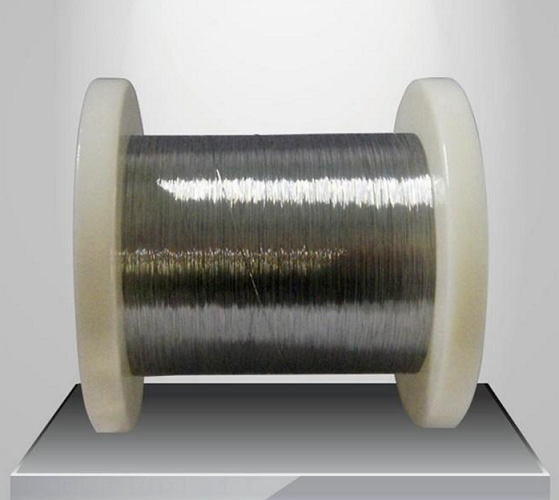
Nickel wire is a metallic wire with good mechanical strength, corrosion resistance, and high heat resistance, making it suitable for manufacturing vacuum devices, electronic instrument components, and filters for strong alkali production in chemical industries. Advantages of nickel wire: 1. Solderability, high conductivity, and suitable coefficient of linear expansion. 2. Good strength at high temperatures and low resistivity. 3. High melting point, corrosion resistance, good mechanical properties, good pressure processing in both hot and cold states, easy to degas, suitable for radio, electric light sources, machinery manufacturing, and the chemical industry; it is an important structural material in vacuum electronic devices.
1. Product Name: High-purity nickel wire, with a purity reaching over 99.96%, and a minimum thickness of 0.025mm.
2. Nickel Wire Grades: N4, N6
3. Nickel Wire Specifications: 0.025mm-6mm
4. Nickel Wire Applications: Wire-wound resistors, electric heaters, heating plates, heating coils, shunts in small appliances (electric kettles, coffee makers, toasters, etc.), precision resistive elements, high-temperature resistant wires and cables for wire-wound resistors, lead wires at the connection points of heating elements, high-temperature nickel-plated ceramic heating element leads, temperature sensing wires, and temperature measuring wires.
5. Physical properties and chemical composition of nickel wire: Quality Bureau certified analysis report.
6. Quality assurance of nickel wire: ISO9001:2000 GB/T 21653-2008
7. Component operating temperature: -30℃ to 1400℃
8. Packaging, marking, transportation and storage of nickel wire shall comply with the provisions of GB/T 8888-2014.
Post time: Apr-15-2026