

Tungsten Carbide’s Dilemma: Diamond-Like Hardness vs. Glass-Like Brittleness
Let’s start with a question that might make you wince:
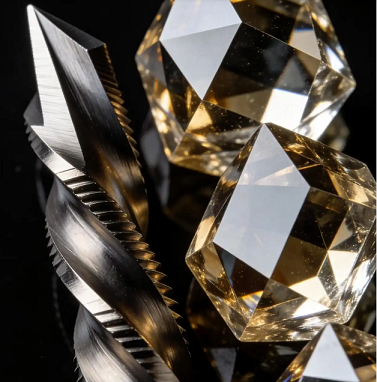
Imagine a metal with a hardness second only to diamond and a melting point as high as 3,400°C—a material capable of cutting through tens of tons of steel—yet one that can only be processed by “shaving” away material, resulting in 70% of the raw stock turning into waste. Wouldn’t that hurt to see?
This is the predicament of tungsten carbide. It is hard enough to make machine tools shudder and shatter rock, yet so brittle that it is difficult to handle without breaking. In traditional manufacturing, a block of tungsten carbide undergoes cutting and grinding, with the majority ending up as expensive “scrap.” Data shows that waste rates range from 50% to 70%.
02
A New Approach from a Japanese Team: “Communicate” Rather Than Conquer
Recently, a group of researchers at Hiroshima University in Japan achieved something that upends conventional wisdom: instead of trying to “conquer” this incredibly tough material, they learned how to “communicate” with it.
2.1 [ Understanding Tungsten Carbide: Hard Enough to Be "Invincible," Yet Challenging Enough to Leave Engineers "Stumped" ]
First, let’s understand what tungsten carbide actually is.
Tungsten is the “heavyweight champion” of metals—boasting a melting point of over 3,400°C, the highest of any metal. When combined with carbon to form tungsten carbide, its hardness skyrockets to a level just below that of diamond. Add cobalt as a binder, and you get “cemented carbide”—an indispensable material in the industrial world.
Machine tool inserts, mining drill bits, and micro-drill bits for PCBs all rely on it.
However, its extreme hardness is also the source of the problem. Traditional manufacturing employs powder metallurgy: tungsten and cobalt powders are pressed into a mold and sintered at high temperatures. It sounds simple, but the yield rate is a gamble—much like opening a “blind box.” Even more frustrating, the finished component is so hard that it can only be shaped by slow grinding with diamond tools; attempting to create complex shapes is simply out of the question. Assistant Professor Keita Marumoto of Hiroshima University puts it bluntly: “Tungsten carbide is made from very expensive raw materials, so minimizing material waste is essential.”
2.2 [ A New Path Forged by Laser ]
The team at Hiroshima University took a path no one had traveled before.
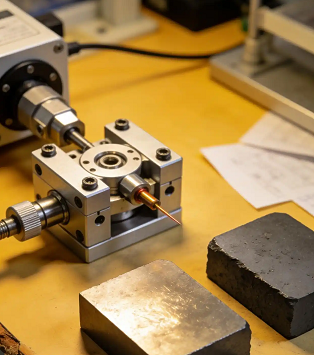
They didn’t aim to melt the tungsten carbide—doing so would cause the material to “act up,” leading to cracks and grain coarsening. Instead, they employed a “hot-wire laser irradiation” method: a laser beam combined with a preheated filler wire. They precisely controlled the temperature—keeping it just high enough above the cobalt’s melting point to turn it into a “glue,” yet just below the critical threshold where tungsten carbide grains would begin to grow uncontrollably.
Simply put, the goal was to “soften” the material rather than “melt” it.
However, things didn’t go smoothly at first. They tried two approaches: one where the alloy rod led the process with the laser aimed directly at its tip, and another where the laser led, focusing on the interface between the rod’s base and the substrate. Neither yielded ideal results; the tip of the material would occasionally decompose, and the hardness fluctuated wildly, like a roller coaster.
The researchers didn’t give up; they pulled a thin sheet of nickel alloy from their toolkit and placed it between the cemented carbide and the substrate. This unassuming transition layer became a crucial buffer and bonding agent.
When the final sample emerged, the hardness tester registered a steady reading above 1400 HV; the interior was flawless, without a single crack.
What does HV mean? Here is a point of reference: ordinary tool steel has a hardness of between 600 and 800 HV. A rating of 1400 HV places this material firmly within the performance range required for industrial cutting tools and mining drill bits—second only to super-hard materials like sapphire and diamond.
More importantly, it proved that 3D printing tungsten carbide is feasible. In traditional manufacturing, large blocks of material are cut and ground down, turning shavings and offcuts into expensive “waste.” In contrast, the philosophy of 3D printing is “precision placement”—material is deposited only where it is needed, effectively nipping waste in the bud. Keita Marumoto notes, “With rapid prototyping technology, cemented carbide can be deposited precisely where needed, thereby reducing material consumption.” While the statement sounds matter-of-fact, it reflects a calculated strategy for managing scarce resources.
03
Strategic Metals in Short Supply: The Global Scramble for Tungsten and Cobalt
Why is such careful resource management so critical? Because tungsten and cobalt are being fiercely contested worldwide.
Let’s start with tungsten. In just the first two months of this year, the price of tungsten skyrocketed by 80%, and the stock prices of relevant listed companies have doubled. China dominates the global tungsten landscape, holding 52% of the world’s reserves and accounting for 83% of its production. When China implemented export controls on tungsten-related items in 2025, global supply chains immediately tightened.
Then there is cobalt. The Democratic Republic of the Congo (DRC) holds a near-monopoly, accounting for 76% of global production. With the DRC implementing an export quota system in 2025, cobalt prices have become volatile. The U.S. Defense Logistics Agency (DLA) has already announced plans to purchase $500 million worth of cobalt for strategic reserves.
These two metals—one providing hardness and the other acting as a binder—are indispensable to one another. Yet, both face tightening supplies: domestic tungsten concentrate mining quotas have dropped year-on-year, and new overseas production capacity is limited. The global supply-demand gap is projected to widen from 12,400 tons in 2024 to 22,000 tons by 2027.
Against this backdrop, increasing material utilization efficiency translates directly into tangible economic gains.
04
Technological Spillover: The “Softening” Method Could Unlock New Possibilities for Hard-to-Process Materials
The significance of this technology from Hiroshima University extends far beyond tungsten carbide alone.
Keita Marumoto made a remark worth pondering: “The method of shaping metal by softening it—rather than fully melting it—is novel; it has the potential to be applied not only to cemented carbide but also to a wide range of other materials.”
Could this gentle approach also unlock materials that are sensitive to high temperatures or notoriously difficult to shape—such as ceramic matrix composites, superalloys, and refractory metals?
The realm of possibility has suddenly expanded.
Of course, the road from the lab to the factory floor remains long. How to minimize cracking rates, how to fabricate complex geometric shapes, and how to translate laboratory elegance into the steady rhythm of a production line—these are the practical challenges that lie ahead.
Yet, that single laser beam has demonstrated that when confronting a world of extreme hardness, humanity need not always resort to ferocious flames to achieve conquest. Sometimes, just the right amount of heat—a “softening” born of understanding—is enough to pry open a crack of possibility within an otherwise impenetrable barrier.
05
A Final Thought: Precise Understanding Is More Powerful Than Brute-Force Conquest
Tungsten carbide is a metal so unassuming that it is rarely mentioned; yet, without it, machine tools would grind to a halt, mining operations would cease, and chip interconnects would fail. In traditional manufacturing, it is a material that is virtually impervious—a “tough nut to crack”—and simultaneously a source of frustration, a “hot potato” that leaves engineers at a loss. The fact that 70% of the raw material ends up as scrap is not due to a lack of technical capability, but rather to a persistent mindset of trying to melt it with intense heat, rather than softening it with the appropriate temperature.
The laser technology from Hiroshima University illuminates not only the shaping process for tungsten carbide but also a new paradigm for high-end manufacturing: true breakthroughs often stem not from aggressive conquest, but from precise understanding. The light from beyond the threshold is already streaming in. Are you ready?
Post time: Jul-03-2026