

Among the cornerstone materials of modern industry, one material, with its unparalleled hardness, exceptional wear resistance, and unyielding rigidity, silently supports crucial links from resource extraction to precision manufacturing. This material is hailed as the “teeth of industry”—tungsten carbide alloys.
I. What are Tungsten Carbide Alloys?
First, we need to distinguish between two concepts: tungsten carbide and tungsten carbide alloys.
Tungsten Carbide: A hard compound with the chemical formula WC. It is composed of tungsten and carbon atoms bonded together in a 1:1 ratio by extremely strong covalent bonds, possessing extremely high hardness (second only to diamond) and a high melting point.
Tungsten Carbide Alloys: Commonly known as cemented carbides. It is not pure WC, but a composite material made by sintering tungsten carbide powder as a framework and metallic cobalt as a binder under high temperature and pressure using powder metallurgy.
You can imagine it as countless incredibly hard tungsten carbide particles, firmly bonded together by a layer of tough cobalt “cement,” forming a superstructure that is both hard and tough. It is this composite structure of “stronger strengths” that gives tungsten carbide alloys unparalleled comprehensive performance.
II. Core Characteristics: Why is it so powerful?
Extremely high hardness and wear resistance: Tungsten carbide alloys have a hardness exceeding HRA90, comparable to high-quality sapphire. This gives it an extremely long service life under cutting, grinding, and impact wear conditions, making it an ideal material for processing steel, cast iron, non-ferrous metals, and even rock.
Excellent rigidity (high modulus of elasticity): It is not easily bent or deformed under stress, maintaining extremely high dimensional stability. This is crucial for precision machining tools (such as milling cutters and boring tools), ensuring the accuracy of machined parts.
Good compressive strength: It can withstand enormous pressure without being crushed, making it suitable for use as drilling tools and molds, able to withstand the immense pressure deep underground or the impact forces during stamping.
**Possible Toughness:** Pure tungsten carbide is brittle like glass. However, the addition of cobalt binder effectively absorbs external impact energy, prevents crack propagation, and imparts the necessary toughness, making it less prone to breakage under impact conditions.
**High Temperature and Corrosion Resistance:** It maintains high hardness (good red hardness) even at high temperatures, making it suitable for high-speed cutting. Simultaneously, it exhibits good corrosion resistance to acids and alkalis.
III. Main Application Areas
Tungsten carbide alloys are found in various industrial sectors:
**Cutting Tools:** This is its largest application area, including lathe tools, milling cutters, drill bits, and planer tools. It is the cornerstone of efficient and precision machining in modern manufacturing.
**Mining Tools:** Rock drill bits, coal cutter teeth, tunnel boring machine cutters, etc. Here, it truly plays the role of “industrial teeth” that “gnaw” through rock formations.
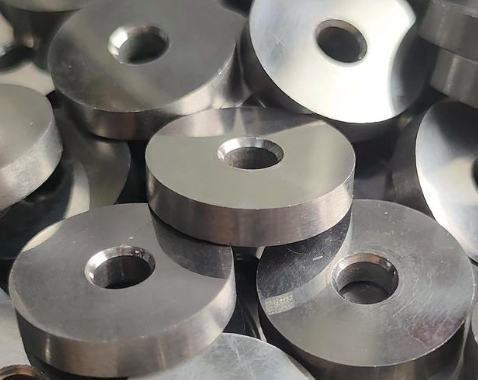
**Wear-Resistant Parts:** Sealing rings, nozzles, rolls, guide plates, etc. Tungsten carbide alloys are useful in any application requiring severe wear resistance.
Mold Materials: Wire drawing dies, cold heading dies, stamping dies, etc. Their high hardness and wear resistance ensure long mold life and dimensional consistency of products.
Everyday Applications: You may not know that some high-end watch cases, jewelry processing tools, and the blades of some outdoor knives also use tungsten carbide alloys to achieve ultimate wear resistance.
IV. Manufacturing Process Overview
The manufacturing of tungsten carbide alloys mainly adopts powder metallurgy. The basic steps are as follows:
Powder Preparation: Tungsten powder is mixed with carbon black and carbonized at high temperature to obtain tungsten carbide powder.
Mixing: Tungsten carbide powder and cobalt powder are mixed evenly in a ball mill for a long time according to a predetermined ratio.
Shaping: The mixture is pressed into the desired shape (such as blades, drill bits, etc.).
Sintering: Sintering is carried out at a high temperature of approximately 1400°C in a protective atmosphere (such as hydrogen, vacuum). At this time, the cobalt melts, tightly bonding the tungsten carbide particles together to form a dense, high-performance final product.
Summary and Outlook
Tungsten carbide alloys are a successful example of combining brittle, hard phases with tough metals. They perfectly balance the seemingly contradictory properties of hardness and toughness, making them an indispensable key material in modern industry.
With technological advancements, the performance boundaries of tungsten carbide alloys continue to be expanded by adjusting tungsten carbide particle size, optimizing cobalt content, adding other carbides (such as TiC and TaC), and employing coating technologies (such as TiN and Al₂O₃ coatings). In the future, it will continue to play an irreplaceable “core” role in a wider range of fields, including high-end manufacturing, new energy, and aerospace.
Post time: May-31-2026