

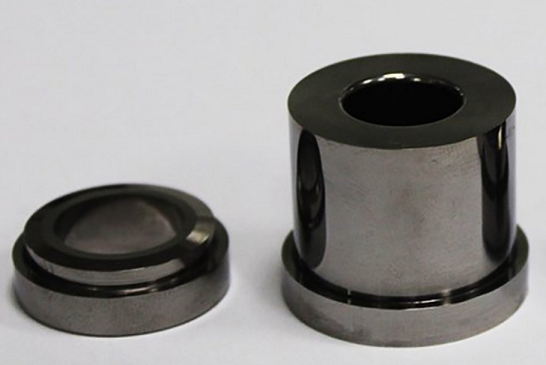
Tungsten steel bushings are common mechanical components in industrial manufacturing, primarily used in applications such as stamping dies and shaft supports. Their core function is to minimize friction and wear during equipment operation through the use of high-hardness materials, while simultaneously withstanding demanding conditions like high temperatures and high pressures. Compared to traditional metal bushings, tungsten steel bushings offer superior temperature resistance and resistance to deformation, making them ideal for industrial projects that require high precision and stability.
I. Material Properties and Structural Principles:
Tungsten steel bushings are composed primarily of tungsten carbide (WC) and cobalt (Co), formed through a powder metallurgy sintering process. Tungsten carbide provides high hardness and wear resistance, while cobalt acts as a binder to enhance toughness; this combination gives the bushing a balance of hardness and impact resistance. The internal structure features a uniform grain distribution, which effectively disperses pressure and prevents cracking caused by localized stress concentrations. Additionally, tungsten steel has a melting point as high as 2870°C and can operate stably for long periods in environments up to 600°C—far exceeding the temperature limits of ordinary steel.
II. Core Applications and Technical Suitability:
In stamping dies, tungsten steel bushings are frequently used in critical components such as guide pillars and guide sleeves. Their high hardness reduces frictional wear during the opening and closing of the die, thereby extending service life. Their high tensile yield strength allows them to withstand the impact forces generated during high-speed stamping, preventing deformation that could compromise product precision. For instance, in the stamping of automotive parts, bushings must endure hundreds of impacts per minute; tungsten steel ensures dimensional stability even after tens of thousands of continuous stamping cycles. Furthermore, their high-temperature resistance makes them suitable for high-heat applications such as hot forging dies and die-casting molds.
III. Customized Design and Practical Advantages:
Tungsten steel bushings can be customized in terms of dimensions, bore diameters, and shapes to suit various die structures. For example, bushings designed with lubrication holes can facilitate oil circulation to reduce the coefficient of friction, while T-shaped designs simplify installation and minimize equipment downtime. Compared to standard off-the-shelf parts, customized bushings align more precisely with equipment specifications, preventing vibration or noise caused by dimensional deviations. Actual testing demonstrates that custom tungsten carbide bushings can extend mold service life by over 30% while reducing maintenance frequency by 15%.
IV. Safety and Maintenance Guidelines:
During installation, ensure the clearance between the bushing and the shaft/bore falls within the 0.01–0.03 mm range; an excessively tight fit may cause seizure due to thermal expansion, while an excessively loose fit compromises precision. Regularly check lubrication status during operation to prevent accelerated wear caused by dry friction. Replace the bushing immediately if surface cracks appear or if dimensional deviations exceed 0.05 mm. Due to the high hardness of tungsten carbide, diamond tools must be used for machining; standard tools may damage the bushing or the equipment.
Post time: Jun-25-2026