

In the non-ferrous metal processing system, there’s a material that’s almost a “regular” in machining workshops—it’s not the strongest, nor the most corrosion-resistant, but it’s one of the most efficient and cost-effective materials. This is C3602 free-cutting brass.
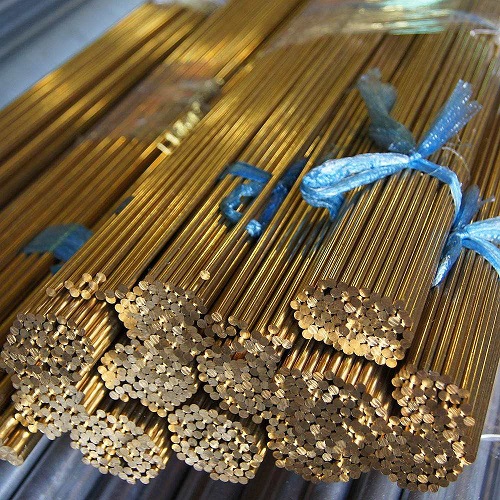
In the high-speed metal cutting world of automatic lathes, C3602 is like an “efficiency champion,” consistently holding a crucial position in hardware parts and precision small structural components due to its extremely high machinability and stable cutting performance.
I. Material Essence: Classic Industrial Design of Lead-Modified Brass
C3602 belongs to the leaded brass system, a free-cutting material formed by adding a small amount of lead to a copper-zinc alloy.
Its typical chemical composition is as follows:
Copper (Cu): Approx. 60%–63%
Zinc (Zn): Approx. 35%–37%
Lead (Pb): Approx. 1.5%–3.0%
The key to this structural design lies in:
Zinc provides basic strength
Copper ensures toughness and electrical conductivity
Lead is the “core of optimized cutting performance”
Lead is distributed in the matrix in the form of tiny particles, acting as a chip-breaking lubricant during machining, thus significantly improving cutting efficiency.
II. Core Performance: Born for “High-Speed Machining”
1. Excellent Machining Performance
The most prominent advantage of C3602 is its machining performance:
Low cutting resistance
Smooth chip removal
Low tool wear
Enables high-speed automatic machining
In automatic lathes and CNC machining, it can achieve:
Higher feed rates
Longer tool life
More stable machining dimensions
Therefore, it is widely known as an “automatic machine tool friendly material”.
2. Good Mechanical Strength (Moderate Level)
Although not a high-strength material, its performance is sufficient to meet structural requirements:
Tensile Strength: Approx. 340–470 MPa
Yield Strength: Approx. 120–250 MPa
Elongation: Approx. 15%–30%
Characteristics:
Moderate strength
Not easily deformed during processing
Good dimensional stability
3. Basic Corrosion Resistance
As a brass material, its corrosion resistance is at a moderate level:
Stable in dry air environments
Performs well in fresh water environments
Requires protection in highly corrosive environments
Suitable for most general industrial and consumer environments.
4. Moderate but Stable Electrical Conductivity
C3602 conductivity is not a primary indicator for its applications:
Conductivity is approximately 25%–30% IACS of pure copper
Therefore, it is more often used for mechanical parts than as an electrical conductor.
5. High Surface Finish
Good surface smoothness after machining:
Easy to achieve low roughness
Reduces subsequent polishing processes
Suitable for precision appearance parts
III. Application Areas: The “Main Material” for Small Parts Manufacturing
1. Precision Hardware Parts (Core Application)
C3602 is widely used in the hardware industry:
Nuts, screws
Small shaft parts
Connecting joints
Precision threaded parts
Especially suitable for mass automated production.
2. Electronic and Electrical Structural Parts
In the electronics industry, it is used for:
Terminal structural parts
Connecting plug parts
Small internal mechanical parts of instruments
Focus on structural stability and machining accuracy.
3. Instrument and Precision Equipment Parts
Common applications in instrument manufacturing:
Precision adjusting screws
Small transmission parts
Fixed support parts
High requirements for dimensional consistency.
4. Automotive and Industrial Equipment Parts
In the automotive industry, it is used for:
Small connecting parts
Auxiliary structural parts
Internal fasteners
Emphasis on batch consistency and reliability.
5. Locks and Daily Hardware
Very common in the consumer goods sector:
Lock cylinder parts
Door and window accessories
Small household hardware items
Reflecting its “high processing efficiency + low cost advantage”.
IV. Material Positioning: A typical “high-efficiency processing material”
The core value of C3602 is not “performance limits”, but “manufacturing efficiency”.
Its positioning can be summarized as:
One of the preferred copper alloys for automated processing
Advantages are very clear:
Fast processing speed
Controllable cost
Suitable for mass production
Good dimensional consistency
V. Advantages compared to other copper alloys
From the perspective of actual industrial applications:
Compared to ordinary brass: Higher processing efficiency
Compared to lead-free brass: Superior machinability
Compared to bronze: Lower cost, faster processing
Compared to high-strength copper alloys: More suitable for small parts
Therefore, it occupies an important position in the “high-efficiency parts manufacturing field”.
VI. Development Trends: High-Efficiency Manufacturing and Environmental Upgrading in Parallel
As the manufacturing industry upgrades, C3602 is also undergoing changes:
Lead-free alternatives are gradually developing (environmental trend)
Demand for automated processing continues to increase
Demand for precision small parts is growing
Cost-efficiency balance remains the core competitiveness
In the future, it will continue to hold an important position in the hardware and machining fields, while gradually evolving into an environmentally friendly free-cutting copper alloy.
C3602 free-cutting brass is not a “high-end material,” but it is an indispensable part of the industrial manufacturing system. Its value lies not in extreme performance, but in its extremely high processing efficiency and stable mass production capabilities.
Behind hundreds of millions of small metal parts, C3602 is often the “silent contributor.” It makes manufacturing faster, more stable, and more economical, which is one of the core efficiency logics of modern industry.
Post time: Apr-29-2026