

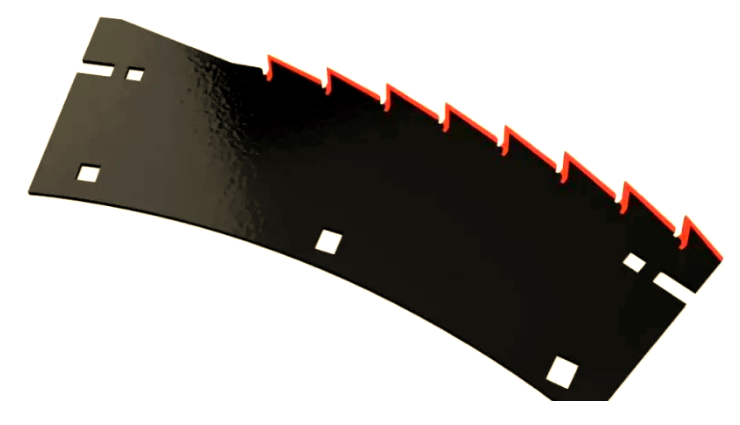
Coating technology is crucial for protecting metal layers, preventing rust and wear, significantly improving product durability, and enhancing key mechanical and physical properties of the substrate, such as hardness, strength, and wear resistance. Tungsten carbide, hailed as a leader among ceramic materials, shines in various fields, including tools, molds, aerospace, automobiles, and machinery, thanks to its high melting point, excellent hardness, outstanding wear resistance, and corrosion resistance. When tungsten carbide is carefully formulated into a coating and applied to metal surfaces, the metal’s hardness, wear resistance, corrosion resistance, and high-temperature resistance are significantly improved. In fact, high-end harvesters, silage harvesters, choppers, pulverizers, and some cutters both domestically and internationally utilize tungsten carbide coating technology to extend their service life.
Tungsten Carbide Coating Preparation Technology
The production of tungsten carbide coatings mainly relies on advanced processes such as physical vapor deposition (PVD), chemical vapor deposition (CVD), and arc ion plating. Physical vapor deposition (PVD) involves sublimating solid materials into a gaseous state in a vacuum environment to form a coating on a substrate surface. Common methods include magnetron sputtering, electron beam evaporation, and arc ion plating. Chemical vapor deposition (CVD), on the other hand, involves decomposing gaseous coatings under specific atmospheres to deposit the products onto the material surface, forming a coating. Methods include CVD, thermal decomposition, and reactant heating.
Characteristics of Tungsten Carbide Coatings
Tungsten carbide coatings are renowned for their exceptional hardness, typically reaching HV1200 or higher. This high hardness stems from a combination of factors, including the tungsten carbide content in the coating, the spraying process used, and post-treatment methods. For example, supersonic flame spraying can produce high-hardness tungsten carbide coatings, while appropriate heat treatment can further optimize the coating’s microstructure and enhance its hardness.
Tungsten Carbide Coating Spraying Techniques
Supersonic Flame Spraying Technology
This technology can rapidly deposit high-hardness, wear-resistant coatings and is considered a potential alternative to hard chrome plating.
**Air-Assisted Supersonic Flame Spraying Technology:** This technology includes two methods: supersonic oxygen flame spraying and supersonic air flame spraying. The flame temperature is relatively low, below approximately 2000 degrees Celsius. This low-temperature environment significantly improves the coating’s bonding strength and reduces oxide content, resulting in coatings with superior wear resistance, corrosion resistance, and toughness compared to electroplated hard chrome layers.
**Arc Spraying Technology:** This technology utilizes powder-cored wire and high-speed arc spraying technology to prepare tungsten carbide coatings in a high-temperature oxidizing environment. Its advantages include producing coatings with excellent comprehensive mechanical properties, high bonding strength, high density, and good vibration resistance.
**Plasma Spraying Technology:** This technology can prepare tungsten carbide coatings with dense structure, high bonding strength, and excellent tribological properties.
**Flame Spraying Technology:** During the spraying process, powder is heated by a heat source and deposited on the workpiece in a semi-molten state. Remelting is the melting process of powder coating on a workpiece. This technology eliminates porosity and oxide inclusions from the spraying process, achieving a metallurgical bond between the coating and the metal substrate. This significantly improves the coating’s density and bonding strength, thereby enhancing the workpiece’s mechanical properties.
Key Points of Tungsten Carbide Spraying:
**Substrate Surface Pretreatment:** Use mechanical methods such as steel wool, supplemented with alkaline cleaning solutions, to thoroughly remove oil and rust from the workpiece surface. Enhance the mechanical bonding strength between the coating and the substrate through sandblasting and electric drawing techniques, controlling the surface roughness within the range of 3-25. Spraying should be performed immediately after sandblasting to prevent moisture contamination of the working surface.
Process Parameter Optimization: Adjust process parameters such as the fuel-oxygen mixing ratio appropriately to ensure spraying quality.
Conveying Gas Selection: Select the appropriate conveying gas type, speed, and flow rate as needed, and determine the optimal conveying position and angle.
Material Selection: Choose suitable tungsten carbide materials, paying attention to parameters such as composition, physical properties, powder state, particle size, and wire or rod diameter.
Spraying Operation Method: Determine the distance between the spray gun and the workpiece, the speed and angle of movement, and the spraying method using the gas medium.
Post-Spraying Treatment: Immediately after spraying, perform sealing and heat treatment.
Safety Precautions: Pay attention to safety precautions during the spraying process.
Price and Lifespan of Tungsten Carbide Coatings:
The price and lifespan of tungsten carbide coatings vary depending on the application, coating thickness, and manufacturing process. Generally, common tungsten carbide coatings range in price from tens to hundreds of yuan, while their lifespan can range from hundreds to thousands of hours. In high-value applications such as cutting tools and abrasives, the coating price is higher, but the lifespan is relatively longer; while in machinery applications such as tractors, the coating price is lower, but the lifespan is correspondingly shorter.
Maintenance Methods for Tungsten Carbide Coatings:
To extend the lifespan of tungsten carbide coatings, appropriate maintenance and upkeep measures are required. This includes avoiding excessive loads that could damage the coating surface, preventing chemical corrosion, and avoiding the effects of high temperatures. These measures maintain the stability and mechanical properties of the coating, thus ensuring its long-term effective use.
Regular cleaning of the coating surface is crucial to prevent the accumulation of dust, dirt, and other impurities, thus ensuring the coating’s performance remains unaffected.
Maintaining a smooth coating surface is equally important, as this reduces mechanical damage such as scratches and wear, thereby protecting the coating’s performance.
By employing tungsten carbide coatings, the wear resistance, corrosion resistance, and fatigue resistance of parts can be significantly improved, thereby extending the overall service life of the parts.
Post time: Jun-04-2026