

The widespread use of molybdenum wire as the electrode in wire-cut EDM (specifically, high-speed wire-cut EDM) is due to a series of excellent material properties that perfectly match the requirements of the process.
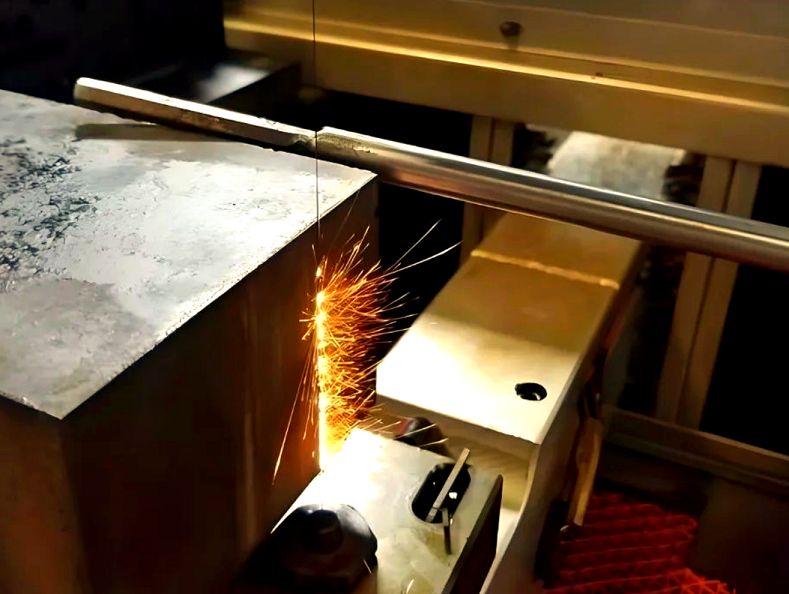
The main reasons can be summarized as follows:
1. Excellent Comprehensive Mechanical Properties
High Strength and Toughness: Molybdenum is a refractory metal with an extremely high melting point (approximately 2620°C), allowing the wire to maintain high tensile strength during machining. The rapidly moving electrode wire (with speeds reaching 8–12 m/s) must withstand immense tension to prevent breakage and minimize vibration, thereby ensuring machining accuracy and stability. At the same time, it possesses sufficient toughness to withstand repeated bending as it passes over guide wheels.
Good Rigidity: Molybdenum wire is rigid and resists bending or deformation when under tension. This is crucial for maintaining a constant spark gap between the electrode and the workpiece—a prerequisite for achieving precise dimensions and high surface quality.
2. Outstanding Electrical Properties
Good Electrical Conductivity: As an electrode wire, excellent conductivity is fundamental to achieving stable electrical discharge machining. Although molybdenum’s conductivity is lower than that of copper, it fully meets the requirements for spark discharge.
High Electron Work Function: During the instant of discharge, the surface of the molybdenum wire can withstand extremely high current densities and temperatures, resulting in relatively low electrode wear. This means the wire wears down slowly during cutting, maintaining dimensional stability over a longer period, which extends service life and ensures machining accuracy.
3. Unique Thermal Properties
Extremely High Melting Point: This is one of the most critical advantages. Wire-cut EDM relies on spark discharge, where local temperatures can exceed 10,000°C. Molybdenum’s ultra-high melting point ensures that the wire does not easily melt or suffer excessive ablation during discharge, guaranteeing the continuity and stability of the machining process. 4. Processing Characteristics and Cost-Effectiveness
Ease of drawing into fine wire: Molybdenum can be processed into extremely fine, dimensionally precise wire. Common molybdenum wire diameters for wire-cut EDM range from 0.10 mm to 0.20 mm, meeting the requirements for machining complex, precision components.
High cost-performance ratio: Compared to other refractory metals like tungsten wire (which is harder but more brittle and costly), molybdenum wire strikes an optimal balance between strength, toughness, service life, and cost. For high-speed wire-cut EDM processes that consume large quantities of wire, molybdenum wire is an economical and practical choice.
Additional Note: Why isn’t molybdenum wire used in slow-feed wire-cut EDM?
To gain a comprehensive understanding, let us compare this with slow-feed wire-cut EDM, which typically employs brass wire or zinc-coated copper wire as the electrode.
Single-use application: Slow-feed EDM utilizes a unidirectional wire feed where the electrode is used only once; consequently, longevity is not the priority—instead, the focus is on achieving exceptional discharge stability and cutting speed.
Different material property requirements:
Brass wire: Offers superior electrical conductivity compared to molybdenum wire, enabling more stable discharge and higher cutting efficiency under specific parameters.
Zinc-coated copper wire: When cutting thick workpieces or hard steel, the zinc coating vaporizes at high temperatures, generating a powerful explosive force that expels molten metal more efficiently, thereby achieving higher speeds and superior surface quality.
Processing environment: Slow-feed EDM operates in deionized water, placing minimal demands on the wire’s corrosion resistance; in contrast, high-speed EDM often uses emulsion-based fluids, in which molybdenum wire performs reliably.
Summary
In conclusion, molybdenum wire is selected for wire-cut EDM (specifically the high-speed variant) because it combines high strength, a high melting point, good electrical conductivity, moderate toughness, and excellent cost-effectiveness. It is an “all-rounder” that delivers balanced performance under various demanding conditions—including high speeds, high temperatures, and high tension. It is the electrode material best suited to the characteristics of the high-speed wire-cut EDM process, as proven by long-term practical application.
Post time: Sep-29-2026