

Which tungsten carbide plate manufacturer is best? This is a question many equipment managers in the ore crushing, aggregate, and metallurgical industries repeatedly compare when purchasing wear-resistant parts for jaw crushers. Tungsten carbide jaw plates, also called jaw plates, are components inside the jaw crusher chamber that directly contact the ore. They are not ordinary steel plates, but rather a composite of a tough matrix and a high-hardness tungsten carbide wear-resistant layer. Tungsten carbide itself possesses high hardness and wear resistance, but its brittleness makes it difficult to use as a structural component alone. Therefore, the key to the manufacturing process is combining the wear-resistant advantages of tungsten carbide with the impact resistance and toughness of the matrix.
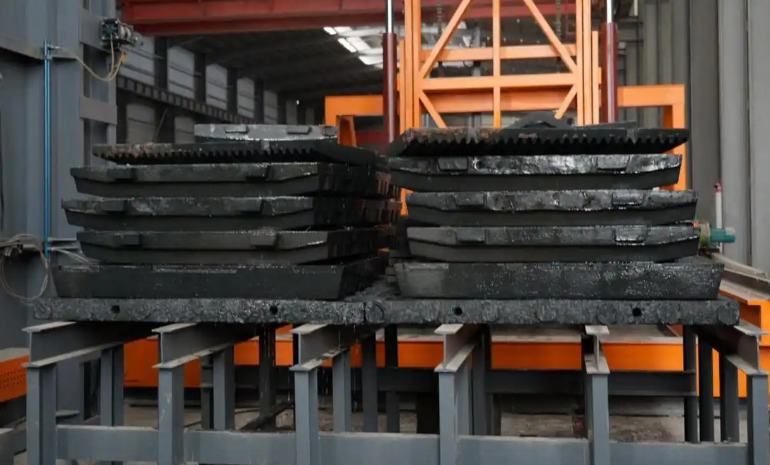
To determine which tungsten carbide jaw plate manufacturer is best, a basic framework can be established: a suitable tungsten carbide jaw plate must be able to withstand continuous friction from the ore and be resistant to breakage under impact. If the tungsten carbide layer is too hard but poorly bonded, it is prone to localized peeling during use; conversely, if the substrate has sufficient toughness but the wear-resistant layer is too thin, the service life will be significantly shortened. Therefore, the manufacturer’s ability to control material proportions and process parameters often determines the basic quality level of the jaw plate.
Specifically, the manufacturer can be evaluated from three perspectives. First, examine the composite process of the tungsten carbide layer. Tungsten carbide is not simply a hard shell “welded” on; it needs to form a strong metallurgical bond or mechanical inlay with the jaw plate substrate. Good manufacturers will adjust the particle size, arrangement, and layer thickness of the tungsten carbide particles according to the different materials being crushed. For example, when crushing highly abrasive river pebbles, the tungsten carbide layer can be thicker; when crushing large pieces of ore with high impact force, the toughness of the substrate needs to be considered. The bonding quality between the tungsten carbide layer and the substrate is an important indicator of the manufacturer’s process capability.
Second, examine the quality control and testing processes during production. The manufacturing of tungsten carbide jaw plates involves multiple processes, including material preparation, forming, lamination, heat treatment, and machining. Fluctuations in any of these processes can lead to variations within the same batch of products. An experienced manufacturer will inspect raw materials upon arrival and check the tungsten carbide layer for cracks, porosity, or delamination risks during the finished product stage. While users cannot immediately see these details at the time of purchase, they can gauge a manufacturer’s confidence by whether they provide process specifications and testing records. The degree of standardization in the production process often determines the quality stability of batch products.
Thirdly, consider selection recommendations and after-sales service. The answer to which tungsten carbide jaw plate manufacturer is best often lies in the details of communication between the two parties. Professional manufacturers won’t just ask “What size do you need?”; they will further understand the material hardness, feed particle size, moisture content, mud content, and crusher model. These factors all affect the stress state and wear pattern of the jaw plate. If a manufacturer can offer suggestions for adjusting the tungsten carbide layer structure based on operating conditions, it demonstrates their practical experience. In addition, jaw plates are consumable parts, so the timeliness of replenishment and the clarity of the replacement process should be understood before purchasing.
During the evaluation process, two common misconceptions should be avoided. One common misconception is using price as the sole criterion. The raw material and processing costs of tungsten carbide jaw plates account for a significant portion of the overall cost. If the price is significantly low, it’s likely that compromises have been made on the amount of tungsten carbide used or the base material. Another common misconception is attributing all issues to “wear resistance.” Tungsten carbide jaw plates also have corresponding application boundaries; their wear resistance advantage can only be fully realized when the material properties match the equipment’s operating conditions.
From the current industry perspective, the differences between tungsten carbide jaw plate manufacturers are not as significant as they appear. Many manufacturers can complete basic production; the main difference lies in their understanding of the material mechanism and their control over details. Instead of asking around “which one is best,” purchasers should first organize their own operating parameters and then compare products with specific questions in mind. The conclusions reached this way will be more reliable than simply relying on advertisements.
Returning to the initial question: Which tungsten carbide jaw plate manufacturer is the best? A more accurate question might be, “Which manufacturer is more suitable for my operating conditions?” We suggest you consider three dimensions: materials and processes, quality control capabilities, and selection services. Request clear process specifications and trial plans from the manufacturer, and conduct small-batch installation tests if necessary. Only through actual comparison can you truly find a tungsten carbide jaw plate product that ensures smoother equipment operation and more reasonable maintenance costs.
Post time: Aug-28-2026