

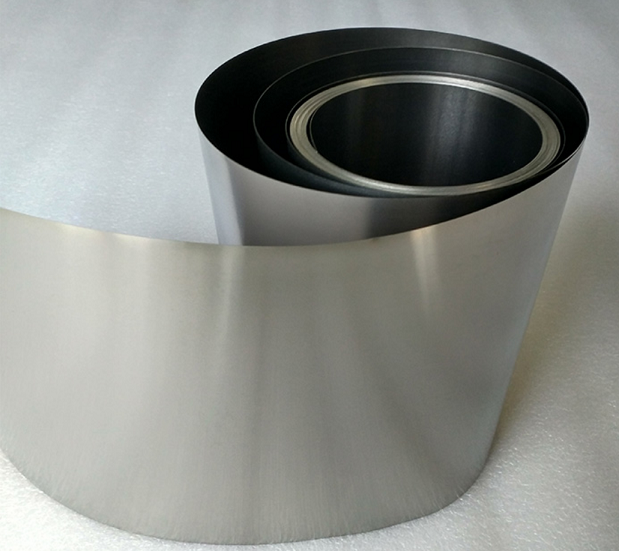
Have you ever seen metal thinner than paper? Molybdenum foil—a form of molybdenum material that can be produced at a thickness of just 0.03mm—looks and feels like a shimmering sheet of “metal paper” when held in your hand. Yet, it can withstand temperatures that would instantly reduce ordinary aluminum foil to ash.
What Exactly Is Molybdenum Foil?
Simply put, molybdenum foil is “molybdenum pressed to an extreme thinness.”
Molybdenum materials are categorized by thickness: anything under 0.1mm is called “foil,” 0.1mm to 2mm is “sheet,” and anything over 2mm is “plate.” Molybdenum foil represents the thinnest category in this family, typically ranging from 0.03mm to 0.1mm in thickness.
Don’t let its thinness fool you; its properties are formidable: a purity of ≥99.95%, a density of 10.2 g/cm³, and a melting point of 2620°C. To put that in perspective: iron melts at 1538°C—meaning that even when iron has been turned into a molten liquid, molybdenum foil remains completely unaffected.
Compared to the aluminum foil found in your kitchen, molybdenum is nearly four times as dense; a sheet of the same size feels noticeably heavy in your hand—a completely different tactile experience.
How Is Such a Thin Metal Produced?
Here’s the interesting part: molybdenum foil isn’t created in a single press; it is “rolled” out, pass after pass.
The process begins with a molybdenum slab created via powder metallurgy. It undergoes hot rolling, followed by warm rolling, to reduce it to a thickness of a few millimeters. It is then fed into a cold-rolling mill, where it is compressed in successive stages. Each pass reduces the thickness only slightly—if you try to compress it too aggressively, the material will simply crack.
Transforming a molybdenum slab into 0.03mm-thick foil requires over twenty rolling passes. With each reduction in thickness, the scrap rate—the likelihood of the material failing—spikes significantly. This is why molybdenum foil is so expensive: the cost reflects both the raw material and the immense amount of labor and precision required.
What Can Such a Thin Metal Be Used For?
You might wonder: why go to such great lengths to make something so thin? The key advantage is that it is “thin yet capable of withstanding extreme heat.”
It is essential for applications such as heat sinks for semiconductor power devices, transition layers in electronic packaging, and multi-layer thermal insulation screens in vacuum furnaces. In these environments, temperatures can easily reach thousands of degrees—conditions in which plastic films would vanish and aluminum foil would melt away. Only molybdenum foil remains stable and fully functional.
About Us
FOTMA ALLOY specializes in the R&D, production, and sales of molybdenum and other refractory metal materials.
We maintain full, in-house control over the entire production process—from raw molybdenum (or tungsten) powder to finished, highly processed products such as sheets, rods, wires, boats, crucibles, and sputtering targets. We also offer custom manufacturing based on your technical drawings.
Post time: Nov-26-2026