

Molybdenum-copper sheets are composite materials produced from molybdenum (Mo) and copper (Cu) via powder metallurgy or infiltration processes. Due to their excellent thermodynamic, electrical, and chemical properties, they are widely used across various sectors: in the electronics industry, they serve as substrates for chip packaging, heat sinks for power devices, and heat sinks for microwave components; in the aerospace sector, they are used for high-temperature spacecraft components and satellite communication antenna substrates; they also function as heat dissipation components for superconducting magnets in medical equipment.
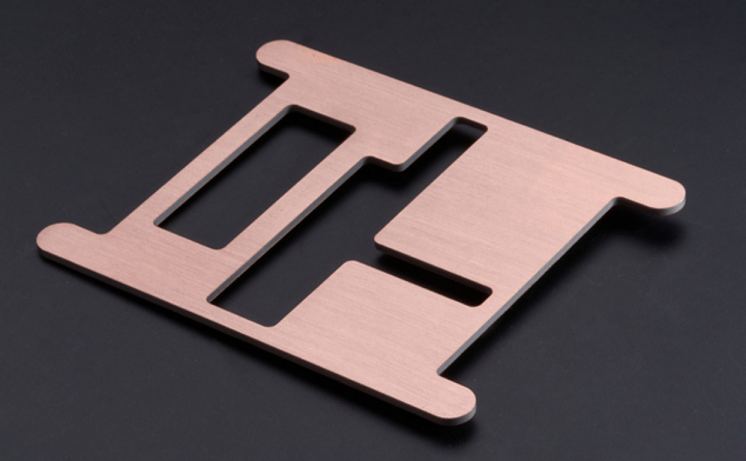
Generally, the physical and chemical parameters of molybdenum-copper sheets vary depending on their composition ratio. At the microscopic level, these sheets exhibit an interlocking structure characterized by a “molybdenum skeleton” filled with copper. The molybdenum phase forms a high-melting-point, high-strength framework, while the copper phase fills the gaps between the molybdenum particles, creating a continuous network for thermal and electrical conduction. This structural design allows the material to harness the superior properties of both components: the high-temperature resistance and low CTE of molybdenum work in synergy with the high thermal and electrical conductivity of copper. Precise performance tuning can be achieved by adjusting the composition.
Key characteristics of molybdenum-copper sheets include high thermal conductivity, a low coefficient of thermal expansion, fatigue resistance, good electrical conductivity, strong corrosion resistance, and excellent machinability. The high thermal conductivity of the copper phase makes these sheets highly efficient for heat dissipation; thermal conductivity generally increases with copper content—for instance, MoCu15 has a thermal conductivity of approximately 195 W/(m·K), while MoCu20 reaches approximately 204 W/(m·K). The low thermal expansion characteristic of molybdenum significantly reduces the overall coefficient of thermal expansion (CTE) of molybdenum-copper (Mo-Cu) composites. By adjusting the Mo-Cu ratio, the CTE can be tuned within the range of 5–10 × 10⁻⁶/℃. For instance, a Mo-Cu composite containing 85% molybdenum and 15% copper has a CTE of approximately 6.8 × 10⁻⁶/℃—a value closely matching that of gallium arsenide (GaAs) chips. This effectively prevents issues such as solder joint cracking or packaging failure caused by thermal stress during high-low temperature cycling, thereby meeting the reliability requirements for aerospace components.
The molybdenum framework imparts excellent mechanical strength to the Mo-Cu composite, with tensile strength increasing as the molybdenum content rises. In high-temperature environments (300–500°C), these composites retain 70%–80% of their room-temperature strength, making them suitable for applications such as high-temperature connectors in spacecraft.
The continuous network of the copper phase ensures good electrical conductivity, allowing Mo-Cu composites to serve as substrates for circuit interconnections or as signal transmission carriers for microwave devices. In high-frequency applications, these composites exhibit low dielectric loss and a magnetic permeability close to that of a vacuum; this prevents interference with electromagnetic waves and ensures stable signal transmission.
Mo-Cu composites can be fabricated into high-precision components through processes such as cutting and laser machining. In semiconductor packaging, for example, they can be laser-drilled to facilitate multi-layer routing or processed via hot rolling into ultra-thin sheets, meeting the integration requirements of microelectronic devices.
Post time: Oct-19-2026