

Tungsten carbide targets are solid materials produced by processing tungsten carbide (WC) powder through specific techniques. Tungsten carbide is a compound with the chemical formula WC, formed by combining tungsten (W) and carbon (C) in specific proportions. Renowned for its exceptional hardness and heat resistance, this material is an ideal choice for manufacturing targets. These targets serve primarily as source materials for thin-film deposition in processes such as Physical Vapor Deposition (PVD) and Chemical Vapor Deposition (CVD).
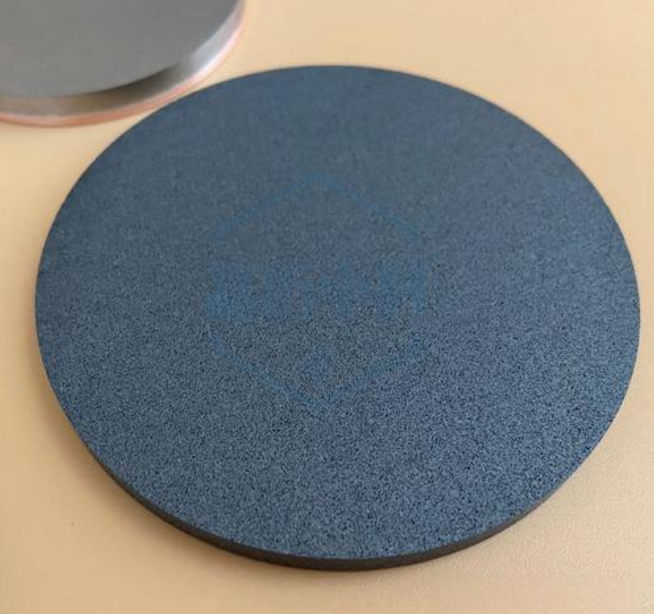
Definition and Composition
Physical Properties
Hardness: Tungsten carbide targets are known for their extreme hardness—second only to diamond—giving them an irreplaceable advantage in the production of hard coatings and wear-resistant materials.
Melting Point: With a melting point as high as 2870°C, tungsten carbide targets remain stable in extreme heat, making them suitable for high-temperature processing applications.
Thermal Conductivity: In addition to heat resistance, tungsten carbide exhibits excellent thermal conductivity, a crucial attribute for applications requiring rapid heat dissipation.
Corrosion Resistance: Tungsten carbide targets resist corrosion from various chemical substances, including acids and alkalis, leading to widespread use in the chemical industry.
Application Value of Unique Properties
Wear Resistance: Thin films produced from tungsten carbide targets can significantly enhance the wear resistance of tools and components, thereby extending their service life.
High-Temperature Stability: Tungsten carbide targets maintain stable physical and chemical properties under high-temperature conditions, making them suitable for sectors requiring extreme reliability, such as aerospace.
Thermal Conductivity Efficiency: High thermal conductivity makes tungsten carbide targets valuable for heat sink materials in electronic devices, helping to improve device stability and performance.
Preparation Methods
Powder Selection and Mixing
Raw Material Selection: Selecting high-purity tungsten powder and carbon black as raw materials is fundamental to ensuring the quality of the final target. The purity of the raw materials directly impacts the purity and performance of the target.
Powder Mixing: Tungsten powder and carbon black are mixed in specific proportions. During the mixing process, it is essential to ensure the two powders are thoroughly blended to guarantee the uniformity of the subsequent chemical reaction.
Carburization
Carburization reaction: The mixed powders undergo a carburization reaction at high temperatures. This step is critical for the formation of tungsten carbide and is typically performed in a vacuum or controlled-atmosphere furnace, with temperatures maintained between 1400°C and 1600°C. Precise control of temperature, time, and atmosphere directly influences the completeness of the reaction and the quality of the product.
**Forming and Pressing**
Forming: The carburized powder is shaped using techniques such as die pressing or isostatic pressing. During this step, the magnitude and duration of the applied pressure directly affect the density and shape of the formed body.
Pressing: The formed body is pressed into the rough shape of the target. Uniform pressure distribution ensures consistent target density, thereby reducing the complexity of subsequent processing.
**Sintering**
Sintering: The pressed tungsten carbide is sintered at high temperatures to enhance its strength and hardness. Sintering temperatures typically exceed 2200°C, and the process can be conducted in a vacuum or hydrogen atmosphere. Parameters such as temperature and duration influence the material’s microstructure, grain size, and porosity during sintering.
**Post-processing**
Post-processing: This stage involves steps such as machining and surface treatment to achieve the required dimensional accuracy and surface finish. The quality of post-processing directly impacts the target’s performance and service life.
**Analysis of Factors Affecting Performance**
Powder purity and mixing uniformity: These affect the chemical homogeneity of the final target, which is directly linked to thin-film quality.
Carburization and sintering conditions: These determine the target’s microstructure and physical properties, such as hardness, melting point, and thermal conductivity.
Post-processing techniques: These influence the target’s surface condition, thereby affecting the uniformity and adhesion of the deposited thin film.
Application Areas
Hard Coatings
Application examples: Tungsten carbide targets are widely used to produce hard coatings for cutting tools and molds, significantly enhancing tool wear resistance and service life.
Impact: In industries such as machining, automotive manufacturing, and aerospace, this hard-coating technology has greatly improved material processing efficiency and quality, driving advancements in manufacturing technology. Microelectronics
Application Example: In the field of microelectronics, tungsten carbide targets are used to deposit conductive and contact layers, thereby optimizing the performance of semiconductor devices.
Impact: This application not only enhances the reliability and performance of electronic devices but also drives the development of miniaturization and integration technologies, exerting a profound influence on modern communications, computing, and consumer electronics.
Aerospace
Application Example: Tungsten carbide targets are used to manufacture high-temperature components and protective coatings for aerospace vehicles, improving the materials’ heat and oxidation resistance.
Impact: This application significantly boosts the performance and safety of aerospace vehicles, enabling the exploration of more extreme space environments and the execution of more complex missions.
Military Industry
Application Example: In the military industry, tungsten carbide targets are utilized to produce wear-resistant coatings for armored vehicles and protective gear, as well as high-performance armor-piercing projectiles.
Impact: These applications not only enhance equipment protection and operational efficiency but also foster the development of advanced protective materials and weapon systems.
New Energy Sector
Application Example: In the new energy sector, tungsten carbide targets are used to manufacture critical components for solar cells and fuel cells, optimizing energy conversion efficiency.
Impact: The use of tungsten carbide targets advances new energy technologies, playing a vital role in promoting the widespread adoption of clean energy and facilitating environmental protection.
Post time: Jul-07-2026