

Both cemented carbide and high-speed steel are typical downstream products of the refractory metal tungsten (W). Both possess excellent thermodynamic properties and can be used to manufacture cutting tools, cold-working dies, and hot-working dies, among other applications. However, due to differences in their material compositions, they also differ in terms of their mechanical properties and intended uses.
I. Conceptual Definitions
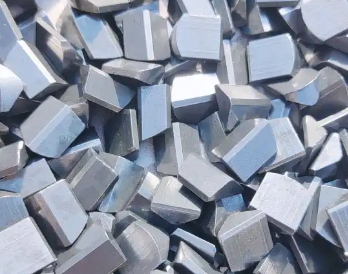
Cemented Carbide is an alloy material composed of refractory metal carbide powders—such as tungsten carbide (WC)—combined with a binder metal, typically cobalt powder. Known in English as “Tungsten Carbide” or “Cemented Carbide,” it features a higher content of high-temperature carbides compared to high-speed steel.
High-Speed Steel (HSS) is a high-carbon, high-alloy steel composed of significant quantities of elements such as tungsten, molybdenum, chromium, cobalt, and vanadium. It consists primarily of metal carbides (e.g., tungsten carbide, molybdenum carbide, or vanadium carbide) embedded within a steel matrix. It typically contains 0.7% to 1.65% carbon, with a total alloy element content ranging from 10% to 25%.
II. Performance Characteristics
Both materials share characteristics such as high hardness, high strength, and excellent toughness, “red hardness” (hardness at elevated temperatures), wear resistance, heat resistance, and processability. However, the specific levels of these attributes vary depending on the particular grade of the material. Generally speaking, cemented carbide outperforms high-speed steel in terms of hardness, red hardness, wear resistance, and heat resistance.
1. Hardness and Wear Resistance:** Cemented carbide possesses higher hardness and superior wear resistance compared to high-speed steel. The hardness of cemented carbide can exceed HRA 90, whereas high-speed steel typically reaches a maximum hardness of around HRC 70. **Toughness:** Relatively speaking, high-speed steel exhibits better toughness, while cemented carbide tends to be more brittle.
2. Performance Disparities:** Regarding the performance of cemented carbide tools: their cutting speeds are typically 4 to 7 times faster than those of high-speed steel tools, and their service life is 5 to 80 times longer. When used to manufacture dies and measuring instruments, their service life is 20 to 150 times longer than that of conventional alloy tool steels.
Cemented carbide materials are capable of cutting workpieces with a hardness of approximately 50 HRC. 3. Performance Aspects: Both materials are characterized by high hardness, high strength, and excellent toughness, hot hardness, wear resistance, heat resistance, and processability. However, the specific manifestation of these characteristics varies depending on the specific grade of the material. Generally speaking, the hardness, hot hardness, wear resistance, and heat resistance of cemented carbide are superior to those of high-speed steel.
4. Distinctions Between Cemented Carbide and High-Speed Steel:
Cemented carbide and high-speed steel are common tool materials, each possessing its own unique characteristics. Cemented carbide is characterized by high hardness, exceptional wear resistance, high corrosion resistance, and high bending strength. It retains significant hardness even at elevated temperatures and exhibits excellent thermal and chemical stability.
5. High-Speed Steel: This is a high-carbon, high-alloy steel. Based on chemical composition, it can be classified into tungsten-series and molybdenum-series steels; based on cutting performance, it is categorized into standard high-speed steel and high-performance high-speed steel. High-speed steel requires heat treatment to achieve its full strength and hardness.
III. Manufacturing Processes
The manufacturing processes for cemented carbide primarily include powder metallurgy, injection molding technology, or 3D printing.
Manufacturing methods for high-speed steel include traditional casting techniques, electroslag remelting, powder metallurgy, and spray forming technology.
IV. Applications
Although both materials can be used to manufacture cutting tools, hot-working dies, and cold-working dies, their performance characteristics differ. Standard cemented carbide cutting tools typically allow for cutting speeds 4 to 7 times higher than those of standard high-speed steel tools, while offering a service life that is 5 to 80 times longer. In the realm of dies and molds, the service life of cemented carbide dies is typically 20 to 150 times longer than that of high-speed steel dies. For instance, a hot-heading and extrusion die made from 3Cr2W8V steel might have a service life of 5,000 cycles, whereas a similar die made from YG20 cemented carbide could achieve a service life of 150,000 cycles.
Products related to this article: Cemented Carbide Products

Author: Ms. Cherry Zhao, over 20 years of experience in Refractory metals industry.
Post time: Mar-29-2026