

From aerospace to medical implants, titanium rods, with their lightweight, high strength, and excellent corrosion resistance, have become a core material in high-end manufacturing. Industrial pure titanium has 10 times the corrosion resistance of traditional materials, TC4 titanium alloy holds 80% of the market share in medical spinal fixation, and TA7 titanium rods can even withstand ultra-low temperatures of -253℃.
Titanium rods are available for retail cutting. Sizes include 10mm, 20mm, 30mm, 40mm, 50mm, 60mm, 70mm, 80mm, 100mm, 110mm, 120mm to 200mm. Titanium rods are metallic materials with titanium and titanium alloys as their main components. Due to their excellent physical, chemical, and mechanical properties, they play an irreplaceable role in aerospace, medical, chemical, and energy fields. The following is an introduction from two aspects: material classification and performance characteristics:
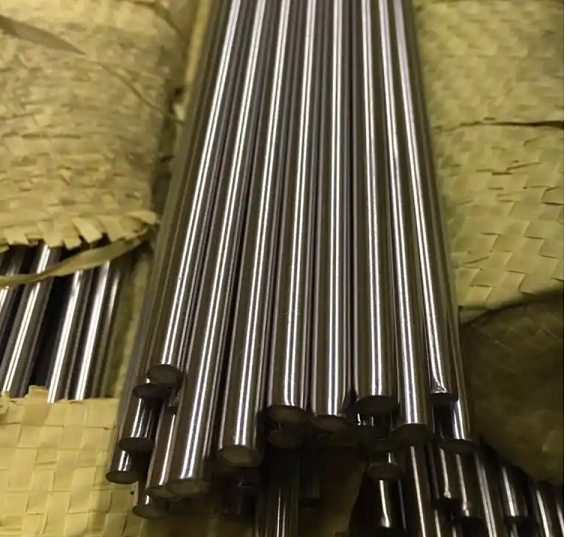
I. Material Classification: Based on composition and microstructure, titanium rods can be divided into four main categories:
**Industrial Pure Titanium Rods (e.g., TA1, TA2)**
Composition: Titanium content ≥ 99.5%, containing small amounts of impurities such as oxygen, nitrogen, and carbon.
Characteristics:
* Excellent corrosion resistance: A dense oxide film forms on the surface, resisting corrosion from seawater, chloride ions, and various acid and alkali media. Its lifespan in environments such as chemical heat exchangers and electrolytic cells is more than 10 times that of traditional materials.
* Good machinability: Easy to stamp, weld, and cut, with low cost, making it a standard material in the chemical industry.
* Moderate mechanical properties: TA2 has a tensile strength of approximately 440 MPa, suitable for corrosion-resistant structural parts.
**α-type Titanium Alloy Rods (e.g., TA7)**
Composition: Contains α-stabilizing elements such as aluminum and tin, forming a single-phase α microstructure at room temperature.
Characteristics:
* High heat resistance: Can operate continuously below 500℃, and can withstand short-term use up to 900℃, suitable for high-temperature components in aero-engines. Good weldability: TA7 exhibits excellent weldability, making it an ideal material for cryogenic (-253℃) environments (e.g., liquid hydrogen fuel tank supports).
Lower room temperature strength: However, its high-temperature strength and creep strength are the highest among the three types of titanium alloys.
α+β type titanium alloy rods (e.g., TC4/Ti-6Al-4V)
Composition: Contains α-stabilizing elements (aluminum) and β-stabilizing elements (vanadium), exhibiting an α+β dual-phase microstructure at room temperature.
Characteristics: High strength and toughness balance: Tensile strength 895-1140 MPa; the phase ratio can be adjusted through heat treatment to optimize strength and plasticity.
Wide applications: Accounts for over 50% of total titanium alloy usage, used in aerospace structural components (e.g., landing gear, compressor blades) and medical implants (e.g., artificial joints, bone screws).
Excellent corrosion resistance: Stable in various media, suitable for chemical and marine engineering.
β-type titanium alloy rods (e.g., TB2)
Composition: Contains β-stabilizing elements such as molybdenum and chromium; single-phase β microstructure at room temperature.
Features:
Excellent cold-working properties: Can be manufactured into elastic elements (e.g., springs) through cold rolling and cold drawing processes.
Heat-treatable: After aging treatment, tensile strength can reach 130-140 kgf/mm², suitable for high-strength applications.
Slightly weaker corrosion resistance: Higher cost; weldability needs optimization.
II. Performance Characteristics: Core Advantages of Titanium Rods
Low density and high strength: Density is only 4.51 g/cm³ (approximately 60% of steel), but its specific strength (strength to density ratio) exceeds that of most alloy steels and aluminum alloys.
Typical example: TC4 titanium rods have a tensile strength of 895 MPa and are 40% lighter than high-strength steel, making them an ideal material for aero-engine compressor blades.
Excellent corrosion resistance: The surface oxide film resists corrosion from seawater, chloride ions, nitric acid, sulfuric acid, etc., significantly extending service life in chemical pumps and valves, and seawater desalination equipment. Special Grade: TA9 (Ti-0.2Pd) further enhances crevice corrosion resistance by adding palladium, making it suitable for chloride-containing chemical media.
Good Biocompatibility: Pure titanium and some titanium alloys (such as TC4 ELI) do not repel human tissues and will not trigger immune or toxic reactions.
Medical Applications: Used in the manufacture of artificial joints, bone screws, dental implants, etc. TC4 titanium rods account for over 80% of the spinal fixation system market.
High and Low Temperature Performance: High Temperature: Alpha-type titanium alloys (such as TA7) can operate continuously at 500℃ and for short-term use up to 900℃.
Low Temperature: Titanium alloys with extremely low interstitial element content (such as TA7ELI) retain ductility at -253℃, making them suitable for cryogenic containers.
Good Machining and Welding Properties: Can be formed through forging, rolling, extrusion, etc., and supports welding methods such as tungsten inert gas welding and plasma arc welding.
Industrial Pure Titanium: Weldability is close to that of stainless steel, suitable for manufacturing complex structures. III. Application Areas: Diverse Scenarios for Titanium Rods
Aerospace: Aircraft frames, engine blades, rocket fuel tanks (utilizing lightweight and high-temperature resistance).
Medical Implants: Artificial joints, bone screws, dental implants (relying on biocompatibility and resistance to body fluid corrosion).
Chemical Equipment: Heat exchangers, reactors, pumps and valves (resistant to acid and alkali corrosion and stress cracking).
Energy & Power: Nuclear power plant heat transfer pipes, deep-sea oil and gas well casings (resistant to high temperature and pressure and radiation).
High-End Manufacturing: Bicycle frames, watch cases, foldable phone hinges (combining lightweight and high strength).
If you are also looking for a high-performance and practical titanium alloy rod, then FOTMA ALLOY’s titanium alloy rod is definitely your best choice! We believe it will bring you unexpected surprises.
Post time: Dec-10-2025