

Tungsten-copper alloys exhibit vastly different properties, ranging from high-tungsten alloys used for armor-piercing projectile weighting to high-copper alloys for electronic heat dissipation. Composition, processing technology, and microstructure determine their applications—selecting the right material requires first defining the requirements, then optimizing the process and structure.
Tungsten-copper alloys (W-Cu) occupy an important position in electronics, military, and aerospace fields due to their high density, high thermal conductivity, and excellent arc ablation resistance. However, the properties of tungsten-copper alloys with different compositions, processing technologies, and microstructures vary significantly. How can they be systematically classified and quickly matched to application requirements?
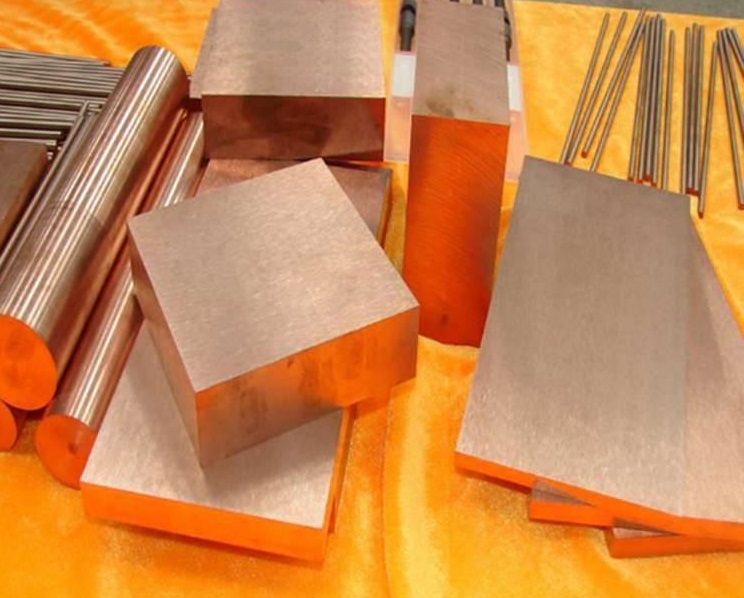
I. Classification by Composition: Tungsten-Copper Ratio Determines Core Performance
1. High Tungsten Alloys (W70%-W90%)
- Composition: W70Cu30, W80Cu20, W90Cu10
- Performance Characteristics:
- Density > 15 g/cm³ (close to pure tungsten)
- High hardness (HV 250-350)
- Low electrical/thermal conductivity (30-50% IACS)
- Metallographic Structure: Continuous tungsten framework, copper filling pores
- Typical Applications: Armor-piercing projectile counterweights, X-ray shielding
2. Balanced Alloys (W50%-W70%)
- Composition: W60Cu40, W70Cu30
- Performance Characteristics:
- Density 12-15 g/cm³
- Electrical conductivity 50-70% IACS
- Optimal overall mechanical properties
- Metallographic Image: Uniformly distributed tungsten-copper dual phases
- Typical Applications: High-voltage electrical contacts, rocket nozzle linings
3. High-Copper Alloys (W20%-W50%)
- Composition: W30Cu70, W50Cu50
- Performance Characteristics:
- Electrical conductivity > 80% IACS
- Thermal conductivity > 200 W/m·K
- Easy to process but low strength
- Metallographic Image: Tungsten particles encapsulated in a copper matrix
- Typical Applications: Electronic packaging heat dissipation substrates
II. Classification by Preparation Process: Comparison of 4 Methods
| Process | Density | Hardness (HV) | Electrical Conductivity | Applicable Composition |
| Powder Metallurgy | 92%-95% | 180-250 | Medium | W50Cu50, W70Cu30 |
| Melt Infiltration Method | >98% | 300-350 | Lower | W80Cu20, W90Cu10 |
| Hot Isostatic Pressing | >99% | 250-300 | High | High-Density Gradient Material |
| 3D Printing | 90%-93% | 200-240 | Medium | Complex Structural Parts |
III. Classification by Microstructure: 3 Key Morphology
1. Tungsten Framework Structure (Melting Method)
- Characteristics: Three-dimensional interconnected tungsten phase, copper filling the gaps
- Advantages: Ultra-high thermal stability (does not soften at >2000℃)
2. Homogeneous Mixed Structure (Powder Metallurgy)
- Characteristics: Uniformly distributed tungsten-copper particles
- Advantages: Isotropic, easy to machine
3. Gradient Structure (HIP + Multilayer Sintering)
- Characteristics: Composition gradually changes from the surface to the interior (e.g., W90Cu10 on the surface → W50Cu50 in the core)
- Advantages: Simultaneously meets the requirements for surface hardness and core thermal conductivity.
IV. Classification by Performance Characteristics: Ranking of 5 Core Indicators
1. Density Ranking: W90Cu10 (17.1) > W70Cu30 (14.5) > W50Cu50 (12.2)
2. Electrical Conductivity Ranking: W50Cu50 (75% IACS) > W70Cu30 (45%) > W90Cu10 (30%)
3. Thermal Conductivity Ranking: W50Cu50 (240 W/m·K) > W70Cu30 (180) > W90Cu10 (120)
4. Hardness Ranking: W90Cu10 (HV 340) > W70Cu30 (260) > W50Cu50 (190)
5. Machinability Ranking: W50Cu50 (Easy) > W70Cu30 (Medium) > W90Cu10 (Difficult)
V. Classification by Application Area
| Area | Preferred Material | Key Requirements | Alternatives |
| Electronic Heat Dissipation | W50Cu50 | High Thermal Conductivity + Easy Machining | Copper-plated Tungsten (W-Cu Coating) |
| Military Armor-Piercing Projectiles | W90Cu10 | Extremely High Density | Depleted Uranium Alloy (Limited) |
| Electrical Discharge Electrode | W70Cu30 | Arc Erosion Resistant | Graphite Copper (Low Cost) |
| Aerospace High-Temperature Components | Gradient W-Cu | Surface Erosion Resistant + Core Thermal Conductivity | Molybdenum-Copper Alloy |
VI. How to Choose a Tungsten-Copper Alloy?
1. First, determine the composition: Select the W/Cu ratio based on density/conductivity requirements.
2. Then, select the process: Melt infiltration (high hardness) vs. powder metallurgy (easy machining). 3. Optimize the structure: Gradient design can overcome performance bottlenecks.
Post time: Mar-18-2026