

U-shaped silicon molybdenum rods, capable of stable operation even at 1600℃, have become the ‘invisible engine’ of industrial production thanks to the oxidation-resistant properties of molybdenum disilicide and precision manufacturing processes. From ceramic firing to semiconductor manufacturing, its 3-5 times longer lifespan is driving efficiency revolutions across multiple industries.
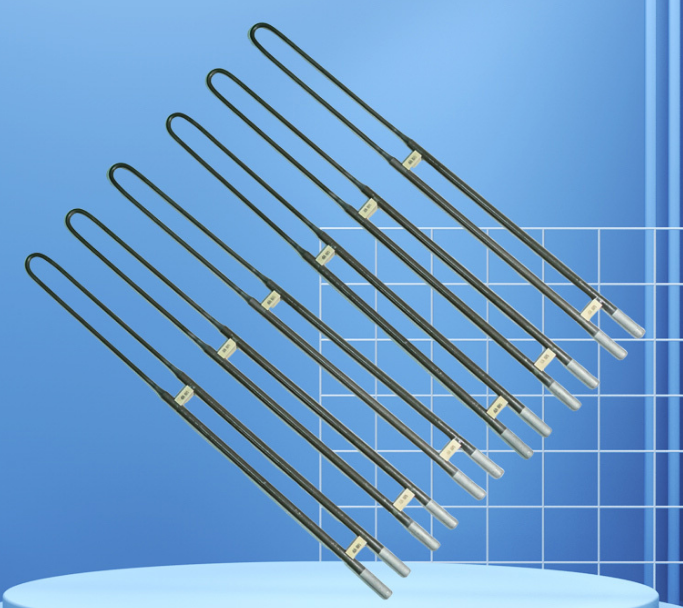
In high-temperature industrial fields such as steel smelting, ceramic firing, and electronic component manufacturing, a component called the U-shaped silicon molybdenum rod silently supports the stable operation of production lines. As a core component of high-temperature electric heating, the U-shaped silicon molybdenum rod factory, through precision manufacturing and material innovation, transforms this seemingly ordinary component into an “invisible engine” of industrial efficiency. This article will unveil the mystery of the U-shaped silicon molybdenum rod factory from three dimensions: technical principles, production processes, and application scenarios.
I. The “Superpowers” of U-Shaped Silicon Molybdenum Rods: A Perfect Balance Between High Temperature Resistance and Oxidation Resistance
The core material of U-shaped silicon molybdenum rods is molybdenum disilicide (MoSi₂). This ceramic-metal compound exhibits unique dual properties at high temperatures: on the one hand, it maintains structural stability in environments above 1600℃, far exceeding the melting point of ordinary metals; on the other hand, a dense protective film of silica forms on its surface, effectively isolating oxygen and preventing oxidation corrosion. This characteristic makes U-shaped silicon molybdenum rods ideal heating elements for high-temperature electric furnaces, vacuum sintering furnaces, and other equipment, especially suitable for scenarios requiring long-term continuous operation.
Compared to traditional nickel-chromium alloy heating wires, the lifespan of U-shaped silicon molybdenum rods can be extended by 3-5 times. For example, in the ceramic firing process, ordinary heating wires may need to be replaced every 3 months due to high-temperature oxidation, while the replacement cycle of silicon molybdenum rods can be extended to more than 1 year, significantly reducing downtime maintenance costs. Furthermore, its uniform heating performance can prevent material deformation caused by localized overheating, improving product yield.
II. From Powder to Finished Product: The Precision Manufacturing Journey of U-Shaped Silicon Molybdenum Rods
The production of U-shaped silicon molybdenum rods involves five core steps: raw material proportioning, cold isostatic pressing, high-temperature sintering, bending, and surface treatment. Among these, raw material purity is crucial to performance: high-purity molybdenum powder and silicon powder must be mixed in a specific ratio, with impurity content controlled below 0.1%, otherwise, the material’s oxidation resistance will be reduced. Cold isostatic pressing technology compresses the powder into a dense blank under high pressure, ensuring no internal pores and providing a foundation for subsequent sintering.
High-temperature sintering is the “soul” of the process. The blank must be sintered at 2000℃ in a vacuum or inert gas environment for more than 12 hours to allow silicon and molybdenum to fully react and form molybdenum disilicide. The sintered rod needs to be laser-cut or waterjet-cut into a U-shape. This step requires extremely high precision—the bending radius error must be controlled within ±0.5mm, otherwise, uneven current distribution during heating will occur, shortening the service life. Finally, the surface oxide layer is removed by sandblasting, and an anti-oxidation coating is applied to further enhance corrosion resistance.
III. Application Scenarios Expansion: Cross-Industry Breakthroughs from Traditional Industries to Emerging Fields
With the rise of industries such as new energy and semiconductors, the application boundaries of U-shaped silicon molybdenum rods are constantly expanding. In the photovoltaic industry, silicon molybdenum rods are used in the heating system of monocrystalline silicon growth furnaces, and their high-temperature stability ensures that the silicon rods do not crack due to temperature fluctuations during the pulling process. In the semiconductor field, their low-pollution characteristics make them an ideal choice for high-temperature diffusion processes in chip manufacturing. Even in the aerospace field, silicon molybdenum rods are used in high-temperature testing equipment that simulates the space environment.
More importantly, U-shaped silicon molybdenum rod manufacturers are exploring higher performance through material modification. For example, adding rare earth elements (such as lanthanum and cerium) can improve the material’s oxidation resistance above 1800℃; 3D printing technology can be used to manufacture complex-structured, irregularly shaped heating elements to meet special operating conditions. These innovations are driving the upgrade of U-shaped silicon molybdenum rods from “industrial consumables” to “functional components.”
Every technological breakthrough in high-temperature industry relies on the support of fundamental components. Through dual innovation in materials science and manufacturing processes, the U-shaped silicon molybdenum rod manufacturer not only provides reliable support for traditional industries but also opens up possibilities for emerging fields. If you are interested in high-temperature technology or industrial manufacturing, you might want to pay close attention to the dynamics of this field—perhaps the next industry-changing innovation lies hidden in the microstructure of a U-shaped silicon molybdenum rod.
Post time: Mar-17-2026