

Properties and Applications of Tungsten Carbide
Tungsten carbide, a material playing a crucial role in numerous industries, is not only frequently associated with metal cutting tools but also widely used in fluid distribution and flow applications. Its superior wear resistance ensures the durability of components such as nozzles used in waterjet cutting, oil and gas, and the electronics industry. It’s important to note that tungsten carbide is not a single substance but rather refers to an alloy composed of actual tungsten carbide, metal binders, and other additive carbides such as TiC and TaC. Cobalt and nickel are two of the most common metal binders. The presence of these binders not only affects the material’s hardness and toughness but also significantly impacts its chemical compatibility. Depending on the specific application requirements, the content of the metal binder in the finished material may vary, typically ranging from 3% to 20%.
Applications in Manufacturing
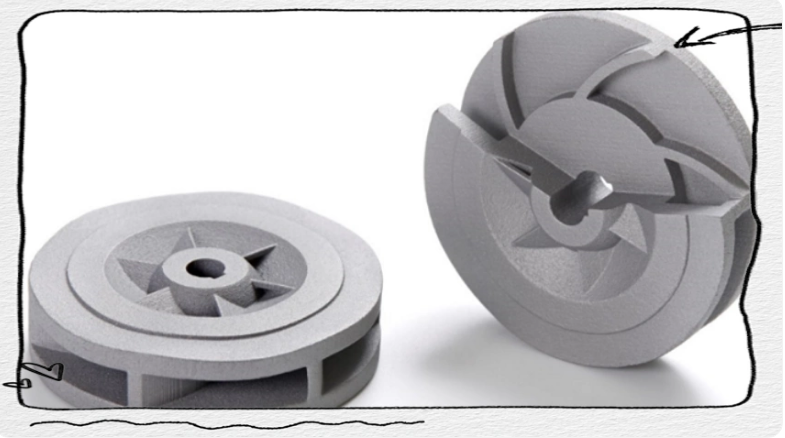
Tungsten carbide is used to manufacture components requiring high strength and wear resistance, such as nozzles and diffusers. Traditional design limitations hindered the realization of complex shapes, but this is changing with technological advancements. In the field of fluid distribution, the manufacture of integrated nozzles and diffusers is also an important application. The curved fluid path design in these components was previously considered difficult to achieve with tungsten carbide, forcing engineers to compromise on suboptimal materials or less efficient geometries, thus increasing customer maintenance costs. However, with the rise of advanced manufacturing technologies such as binder spraying and FDM, these challenges have been gradually overcome.
Tungsten Carbide Processing
Powder Preparation and Sintering Process: Preparing tungsten carbide powder requires spray drying and high-pressure compaction to form a green compact, which is then sintered at 2500-2700°F. This process causes shrinkage, requiring subsequent machining using grinding and EDM. Ready-to-Press powder preparation involves incorporating tungsten carbide (WC) powder, a metal binder, and an organic binder into a solvent, removing the solvent through spray drying, and then compacting the powder in a press to form a green green compact with chalk-like strength. Although the green compact is relatively fragile, it can be initially machined using conventional turning, milling, and drilling techniques. It is worth noting that the green compact shrinks during sintering due to shrinkage, so extra care must be taken when calculating the geometry. The sintering temperature ranges from 2500 to 2700°F. During this process, the metal binder melts, the part becomes soft, and thin-walled areas may collapse. After sintering, the part is in a hardened state, at which point conventional turning, drilling, or welding is no longer possible. Therefore, subsequent machining can only be performed using grinding and electrical discharge machining (EDM), which are not only costly but also have limited capabilities for machining specific geometries.
The Transformation Brought by Emerging Technologies Advanced technologies such as binder jetting and FDM enable the creation of complex geometries in tungsten carbide, driving applications in pump design and fluid distribution, enhancing customer value and design capabilities. The manufacture of screw pump rotors (Moineau principle) is a prime example. Their complex geometry makes molding in the raw part or grinding in the finished part impossible. However, these emerging technologies provide pump designers with new weapons against abrasive wear when facing challenging liquid pumping tasks. By partnering with Hyperion’s Precision Solutions, customers are able to leverage its expertise in rigid materials, combined with state-of-the-art manufacturing technologies, to create complex geometries that were previously impossible. This not only adds value for customers but also drives technological advancements in the field of fluid distribution.
Post time: Sep-01-2026