

With the rapid development of high-power-density, high-performance electronic devices, efficient heat dissipation has become a key bottleneck restricting performance breakthroughs. Diamond, with its stable, uniform, and highly ordered cubic lattice structure, achieves extremely high phonon conduction efficiency, giving it excellent thermal conductivity. Single-crystal diamond can achieve a thermal conductivity of up to 2200 W/(m•K), far exceeding traditional thermal conductive materials, showing broad application prospects in the field of thermal conductivity. However, the high cost and brittleness of diamond limit its application in single forms. This has led to the development of diamond composite materials, which have become a research hotspot in the industry and are core candidates for next-generation heat sinks and electronic packaging materials.
1. Polymer-Based Diamond Thermally Conductive Composite Materials
Polymer thermally conductive composite materials have advantages such as lightweight, good processability, and low cost. They are widely used in electronic devices as thermal interface materials to fill the gaps between the surface of microelectronic materials and heat sinks, eliminating air and improving heat dissipation performance. The thermal conductivity of the thermal interface material largely depends on the thermal conductivity of the thermally conductive filler. Among various thermally conductive fillers, diamond has a high thermal conductivity and excellent insulation properties, making it an excellent filler for preparing high thermal conductivity and insulating composite materials.
However, the interfacial compatibility between diamond fillers and the matrix is relatively poor, and a large interfacial thermal resistance is easily generated near the interface, which seriously affects the overall thermal conductivity of the material. Therefore, surface modification treatment of diamond is often required. Diamond surface modification methods can be mainly divided into three categories: silane coupling agent treatment, surfactant treatment, and surface functionalization.
(1) Silane Coupling Agent. Synthetic diamonds produced by chemical vapor deposition still retain organic groups such as hydroxyl and carboxyl groups. One end of the silane coupling agent can react and bond with these groups, while the other end can react with the polymer to form chemical bonds, thereby tightly binding the diamond to the polymer matrix and improving its interfacial interaction.
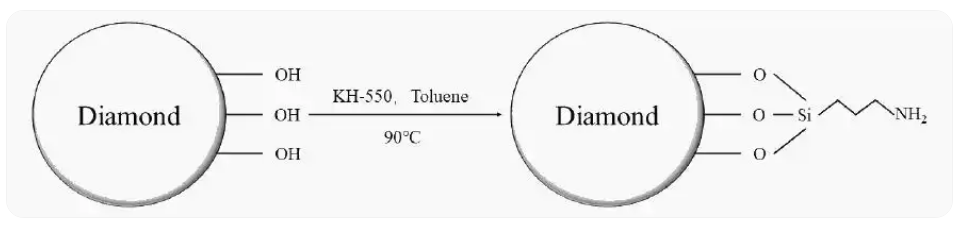
Reaction mechanism of silane coupling agent KH-550 with diamond
(2) Surfactant Treatment. Surfactants are substances containing hydrophilic and/or lipophilic groups that can form directional arrangements on the surface of a solution. Surfactants often bind to diamond at one end and the matrix at the other, significantly enhancing the interfacial bonding between the two phases.
(3) Surface Functionalization. Surface functionalization mainly refers to introducing organic functional groups onto the surface of diamond through methods such as chemical modification, photochemical modification, and ozone oxidation, thereby improving the interfacial affinity between diamond and organic polymers.
2 Metal-Based Diamond Thermally Conductive Composites
Based on the excellent physical properties of diamond, such as high thermal conductivity, low coefficient of expansion, and low density, researchers have been developing metal-based high thermal conductivity composites with diamond particles as reinforcement in recent years. Diamond/metal composites have significant application potential in the encapsulation field due to their excellent thermophysical properties. Currently, metal-based diamond composites mainly include diamond/copper, diamond/aluminum, and diamond/magnesium composites.
Diamond/Copper: The copper matrix itself possesses excellent thermal conductivity, making it a significant player in the heat sink materials for electronic devices. It effectively dissipates heat, maintaining equipment at low temperatures and ensuring stable operation of electronic components.
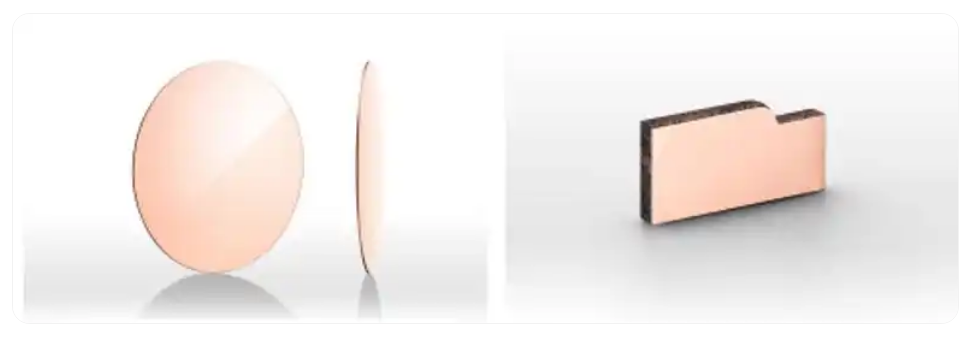
Diamond-Copper
Diamond/Aluminum: Through appropriate manufacturing processes, diamond particles and the aluminum matrix can achieve a good interfacial bond, improving the overall performance of the composite material. Aluminum’s lower density also helps reduce the overall weight of the structure, making it suitable for thermal management applications in aerospace and other fields.
Diamond/Magnesium: Compared to the aluminum matrix, magnesium-based composites have a lower density and slightly higher strength. However, the significant difference in the coefficients of thermal expansion between diamond and magnesium can lead to thermal stress in the composite material under temperature changes. Research on this composite material is currently in its early stages.
The interfacial compatibility between diamond and the metal matrix is poor, and phonon scattering at the interface is severe, resulting in limited thermal conductivity of the composite material. The following interfacial modification techniques can improve the thermophysical properties of diamond/metal composites:
(1) Enhancing interfacial bonding strength:
Preparation process optimization: By adjusting process parameters such as temperature, pressure, and time during composite material preparation, the density of the diamond/metal composite can be increased, enhancing interfacial bonding and thus improving the thermal conductivity and flexural strength of the composite.
Changing the surface state of diamond particles: Changing the surface roughness and surface chemical state can affect the thermal conductivity and adsorption properties of diamond/metal composites.
(2) Introducing an interfacial transition layer:
Matrix metal alloying: Adding appropriate alloying elements to the matrix can generate strong internal interfacial adsorption, effectively reducing the interfacial tension within the liquid alloy.
Diamond particle surface metallization: Using processes such as chemical plating, vacuum micro-evaporation plating, salt bath plating, and magnetron sputtering to deposit a metal layer on the diamond surface reduces surface tension and promotes wetting.
Introducing a functional transition layer: One or more transition layer materials, such as carbides (e.g., TiC, WC), nitrides, etc., are introduced between diamond and the metal matrix. These transition layer materials possess good thermal and chemical stability, effectively reducing phonon scattering at the interface and improving thermal conductivity.
Contact us to get lastest developement of Diamond Composite Materials!
Post time: Mar-04-2026