

Chemical Composition and Structure
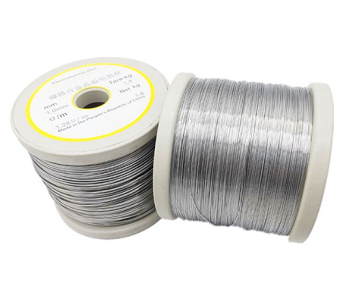
1. Tungsten wire is mainly composed of tungsten. It typically uses high-purity tungsten or doped tungsten wire (containing small amounts of potassium, silicon, and aluminum oxides). Its structure is metallic and non-magnetic.
2. Nichrome wire is a nickel-chromium alloy, commonly graded as Cr20Ni80 (80% nickel, 20% chromium). Its structure is austenitic, and it is non-magnetic or only slightly magnetic.
Physical and Thermal Properties
1. Tungsten wire has a particularly high melting point (approximately 3400°C) and relatively low resistivity (5.3 × 10⁻⁸ Ω·m). It has high strength at high temperatures but is brittle.
2. Nichrome wire has a melting point of approximately 1200-1400°C and relatively high resistivity (1.09-1.18 × 10⁻⁶ Ω·m). It has stable strength and good ductility at high temperatures.
High Temperature Resistance and Oxidation Resistance
1. Tungsten wire has excellent high temperature resistance, suitable for ultra-high temperature environments (e.g., 2300-2800°C), but its high coefficient of thermal expansion makes it prone to breakage due to thermal expansion and contraction.
2. Nickel-chromium wire also has good high temperature resistance (up to 1200°C), a low coefficient of thermal expansion (18-19×10⁻⁶/°C), and stable morphology at high temperatures.
Thermal Conductivity and Oxidation Resistance
1. Tungsten wire has poor thermal conductivity, requiring careful control of heating time to avoid localized overheating; it also has weak oxidation resistance and is prone to oxidation with prolonged use at high temperatures.
2. Nickel-chromium wire has moderate thermal conductivity (43-60 kJ/m·h·°C), easily forms a Cr₂O₃ protective film on its surface, and exhibits excellent oxidation and corrosion resistance.
Application Scenarios Differences
Electrical Heating vs. Resistance Applications
1. Tungsten filament is mainly used in incandescent lamps, halogen lamps, and high-temperature sterilization equipment (such as anaerobic bacteria experiments), suitable for one-time or short-term high-temperature use.
2. Nickel-chromium wire is widely used in industrial furnaces, household appliances (electric irons, electric heating elements), and resistors (fixed resistors, variable resistors), suitable for long-term stable heating.
Mechanical Properties and Applicable Scenarios
1. Due to its brittleness, tungsten filament should avoid frequent bending or mechanical stress, and is mostly used in fixed high-temperature scenarios.
2. Nickel-chromium wire has good mechanical properties and can be processed into spiral or spring shapes, suitable for heating elements that require frequent adjustment or movement.
Cost and Lifespan Considerations
1. Tungsten filament has low cost but short lifespan (easily breaks), requiring frequent replacement, suitable for low-cost or one-time applications.
2. Nickel-chromium wire has high manufacturing cost (due to nickel content), but long lifespan and high durability, offering better cost-effectiveness in the long run.
Usage Precautions
1. Tungsten filament performs well in high-temperature sterilization scenarios, but caution must be exercised during handling (poor thermal conductivity increases the risk of burns).
2. Nickel-chromium filament offers high cost-effectiveness in routine microbial inoculation or teaching scenarios, but prolonged use at high temperatures may lead to surface oxidation, affecting efficiency.
Performance Advantages and Disadvantages Summary
Advantages Comparison
1. Tungsten filament advantages: Excellent high-temperature resistance, low cost, suitable for ultra-high temperature sterilization or short-term high-temperature applications.
2. Nickel-chromium filament advantages: High resistivity, high heating efficiency, strong oxidation resistance, long lifespan, suitable for long-term stable heating.
Limitations Analysis
1. Tungsten filament limitations: Brittle, easily broken, poor thermal conductivity, requires careful handling.
2. Nickel-chromium filament limitations: Higher cost, weaker oxidation resistance at high temperatures, and slightly lower thermal conductivity than platinum-iridium alloys.
Applicability Recommendations
1. Scenarios for choosing tungsten filament: Scenarios requiring ultra-high temperatures (e.g., light bulb filaments, specific anaerobic bacteria experiments), cost-sensitive, or for single-use applications.
2. Scenarios for choosing nickel-chromium wire: Applications requiring stable heating (e.g., industrial furnaces, household appliances), long-term use, or high cost-effectiveness.
3. Tungsten wire should be protected from mechanical stress and frequent thermal cycling. Nickel-chromium wire requires regular inspection for surface oxidation to maintain efficiency.
Post time: Feb-23-2026