

I. Common Grades and Composition Characteristics
Carbide button bit grades are typically designated by a combination of letters and numbers, with different grades corresponding to specific compositional ratios. For instance, YG8 represents a tungsten-cobalt alloy containing 8% cobalt, making it suitable for medium-impact working conditions; conversely, YG11C contains 11% cobalt and exhibits superior toughness. The grain size of the tungsten carbide particles also influences wear resistance: fine-grained structures are ideal for precision drilling, while coarse-grained structures offer greater resistance to impact.
The term “button bit” does not refer to a specific model within the YG carbide series, but rather denotes any carbide product featuring a spherical, button-like geometry. “YG” serves as the code for tungsten-cobalt-based carbides, with the trailing number indicating the percentage of cobalt content. For example, YG8 contains 8% cobalt and is suited for medium-impact conditions; YG15 contains 15% cobalt, offering enhanced toughness but slightly reduced wear resistance.
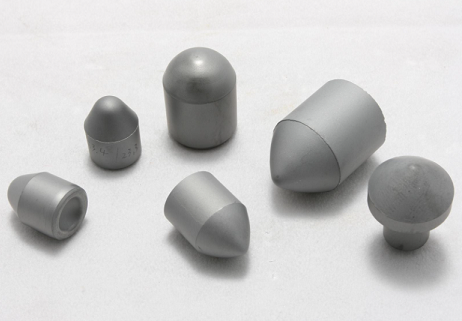
II. Button Bit Structure and Working Principles
The hemispherical design of the button bit is not coincidental; it serves specific functional purposes:
Stress Dispersion: The curved surface effectively and uniformly distributes the impact forces generated by the drill bit.
Self-Sharpening Effect: As the bit wears down during operation, new, sharp cutting edges are continuously exposed.
Chip Evacuation Optimization: The spherical profile facilitates the rapid and efficient discharge of rock cuttings.
The core performance of the bit is fundamentally determined by the microscopic bonding state between the hard phase (tungsten carbide) and the binder phase (cobalt).
III. Practical Guidelines for Selection
Selecting the appropriate grade based on actual working conditions is the scientifically sound approach:
Choosing a button bit is akin to selecting a pair of athletic shoes—the key lies in identifying the specific application scenario:
Soft Rock Formations: Prioritize wear resistance; select grades with lower cobalt content.
Hard Rock Formations: Require high impact resistance; select grades with higher cobalt content.
Composite Formations: Consider grades featuring gradient alloys or specialized surface coatings.
Granite Drilling: Opt for fine-grained grades such as YG6X, prioritizing wear resistance.
Geological Exploration Bits: Commonly utilize YG8X; its unique grain structure enhances penetration capability.
Coal Mine Roadways: Consider YG11C, which emphasizes impact resistance while striking a balance between toughness and wear resistance.
Deep-Hole Drilling: Requires grades that also account for thermal conductivity, such as YG8W.
Tunneling and Heading Operations: Tend toward YG13, which is well-suited for high-frequency impact environments.
In environments characterized by high humidity, consider grades that incorporate rare metals for enhanced performance.
IV. Advantages:
Carbide button bits possess superior wear resistance and impact toughness, offering higher drilling speeds compared to similar products. The button bit series features a long service life before blunting; specifically, its service life between resharpening—or “unsharpened life”—is approximately 5 to 6 times that of blade-type bits of the same diameter. This contributes to saving auxiliary labor time, reducing physical exertion for workers, and accelerating project progress.
Post time: Mar-14-2026