

Today, we’d like to introduce a carbide YG13X blade specifically customized for the Omani market, with dimensions of D265*H112*T1.5. This blade is designed specifically for MINGWEI equipment and is primarily used for cutting corrugated cardboard. Its dimensions are strictly customized to customer requirements, ensuring cutting precision and efficiency.
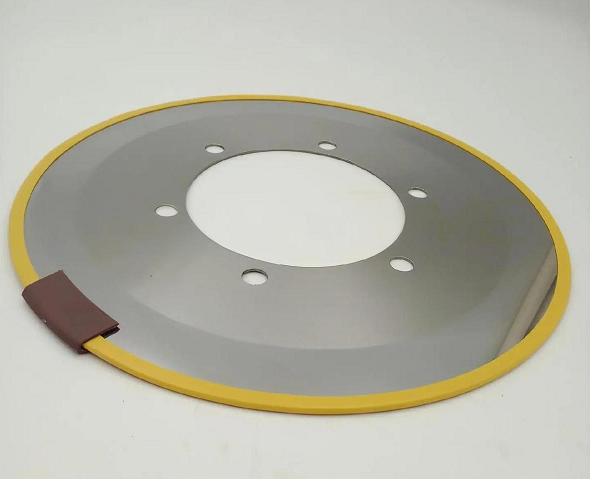
Carbide blades, also known as tungsten carbide blades, are renowned for their exceptional hardness and sharpness. Different materials can be selected depending on the application and design. For the corrugated cardboard industry, commonly used materials include high-speed steel (high-speed steel blades) and carbide (tungsten carbide blades). Carbide is favored by many customers due to its high efficiency and durability.
Carbide raw materials come in various types, such as YG13X, YG12, YG8, and YG10. Different grades of carbide raw materials have different properties; the appropriate selection must be made based on the processing object and specific cutting requirements.
Carbide inserts are extremely sharp, so protective measures must be taken when inspecting them to avoid direct hand contact with the cutting edge. Furthermore, due to their brittleness, carbide inserts require careful handling, storage, and use; they should be placed horizontally to avoid collisions with other hard objects.
Product Features:
1. High Hardness and Wear Resistance
Hardness is a fundamental characteristic of machine tool insert materials. For a machine tool insert to cut chips from a workpiece, its hardness must be greater than the hardness of the workpiece material. The cutting edge hardness of machine tool inserts used for cutting metals is generally above 60 HRC. Wear resistance is a material’s ability to resist wear. Generally, the higher the hardness of the machine tool insert material, the better its wear resistance. The higher the hardness, the greater the number, the smaller the particles (carbides, nitrides, etc.) in the microstructure, and the more uniformly distributed they are, the better the wear resistance. Wear resistance is also related to the material’s chemical composition, strength, microstructure, and the temperature of the friction zone. The wear resistance (WR) of a material can be expressed by the formula: WR = KICO.5E – 0.8H1.43 Where: K — material hardness (GPa); E. The higher the hardness, the better the wear resistance.
2. Sufficient Strength and Toughness
To enable machine tool inserts to operate under high pressure and the frequent impacts and vibrations during cutting without chipping or breaking, the material must possess sufficient strength and toughness.
3. High Heat Resistance (Thermal Stability)
Heat resistance is a primary indicator of the cutting performance of machine tool insert materials. It refers to the material’s ability to maintain certain hardness, wear resistance, strength, and toughness at high temperatures.
Machine tool insert materials should also possess resistance to oxidation at high temperatures and good anti-adhesion and anti-diffusion capabilities; that is, the material should have good chemical stability.
4. Good Thermophysical Properties and Thermal Shock Resistance
The better the thermal conductivity of the machine tool insert material, the easier it is for cutting heat to dissipate from the cutting zone, which helps to reduce the cutting temperature.
Mechanical cutting tools are often subjected to significant thermal shock (drastic temperature changes) during intermittent cutting or when using cutting fluid, which can cause internal cracks and lead to breakage. The thermal shock resistance of mechanical cutting tool materials can be expressed by the thermal shock coefficient, R, defined as: R = λab(1-u)/Ea
Where: λ—thermal conductivity;
ab—tensile strength;
u—ratio of α to β;
E—modulus of elasticity;
a—coefficient of thermal expansion.
A high thermal conductivity facilitates heat dissipation, reducing the temperature gradient on the surface of the cutting tool; a low coefficient of thermal expansion reduces thermal deformation; a low modulus of elasticity reduces damage caused by thermal deformation.
Our factory mainly deals in superhard grinding wheels and blades for the corrugated paper and tissue paper industries. Products for other industries can also be customized according to drawings or samples. Inquiries are welcome!
Post time: Jan-30-2026