

With the rapid advancement of information technology, microelectronic technology has emerged and gradually become a mainstream focus of scientific and technological development in my country. As microelectronic technology continues to evolve, the power density of these systems has steadily increased, leading to higher demands—and greater scrutiny—regarding the reliability and cost-effectiveness of heat sink materials used in microelectronic packaging. The primary function of these heat sink materials is to absorb excess heat generated by electronic components and dissipate it into a cooler external environment, thereby ensuring that the components operate within an appropriate temperature range.
As technology progresses, an increasing number of electrical devices—all utilizing microelectronic integrated circuits—have become integral to our work and daily lives. However, due to the high density of these integrated circuits and the significant heat generated by their miniature components during operation, the limited heat-dissipation capacity of existing packaging materials often becomes a major cause of device failure. In this new era of technological advancement, the focus of research on microelectronic packaging heat sink materials has shifted from a device-centric approach to a system-centric one, reflecting a new trend in the evolution of packaging technology.
I. Current Status of Research on Heat Sink Materials for Microelectronic Packaging
As research has deepened, it has become widely recognized that enhancing the power capacity of electronic components hinges on improving the reliability of their packaging heat sink materials. Consequently, there is a pressing need to advance research in this field to meet the growing demands placed on electronic components. The development of heat sink materials for microelectronic packaging is driven by two key advantages: first, these materials can effectively absorb the heat emitted by electronic components; second, they can transfer this absorbed heat to a cooler environment, ensuring that all parts of the electronic components remain within an optimal operating temperature range. Different heat sink materials offer distinct advantages. As metal-based heat sinks are tasked with supporting chips, providing electrical connections, dissipating heat, and offering environmental protection, they must meet the following requirements:
First, they must have a low coefficient of thermal expansion (CTE) to ensure compatibility with the chip. Second, they must possess high thermal conductivity to facilitate effective heat dissipation.
Third, they must exhibit high electrical conductivity, which is crucial for the stable operation of electronic components.
Fourth, they must have good machinability and formability, which are fundamental for their application in electronic devices.
Fifth, they should offer good corrosion resistance and solderability to ensure a long service life.
Finally, the material must provide hermetic sealing. Since any mismatch in the coefficient of thermal expansion between the heat sink and the chip can generate thermal stress—potentially leading to the deformation of electronic components—it is essential to carefully evaluate the CTE of materials intended for use as packaging heat sinks. Due to their favorable properties, metal-based heat sinks are highly valued by electronic engineers and are widely used in the manufacturing of electronic components.
II. Heat Sink Materials for Microelectronic Packaging
Research into heat sink materials for microelectronic packaging in my country has made significant strides. Several metals and alloys have been identified as suitable candidates, such as Invar and Kovar. Each of these materials has its own set of advantages and limitations. In the following section, we will examine several types of heat sink materials for microelectronic packaging to analyze the current state of research in my country.
2.1 Molybdenum-Copper and Tungsten-Copper Alloys
Copper can be alloyed with tungsten or molybdenum in any proportion. Both tungsten-copper and molybdenum-copper alloys serve as excellent heat sink materials for microelectronic packaging. By adjusting the composition, these alloys can be tailored to meet specific coefficient of thermal expansion requirements. Each alloy offers unique benefits: tungsten-copper alloys provide enhanced thermal conductivity, while molybdenum-copper alloys offer a lower density, which is advantageous in terms of weight. These materials are typically produced using powder mixing or melt-infiltration methods; such processes increase the density of the alloys and, consequently, enhance their stability. 2.2 CMC
CMC is a composite material consisting of three layers: copper on the top and bottom surfaces, with a layer of molybdenum in the middle. The thickness ratio of these three layers can be adjusted to meet specific requirements for the coefficient of thermal expansion (CTE). CMC is fabricated using explosive bonding and rolling processes, which ensure a tight, robust bond between the three layers.
2.3 CPC
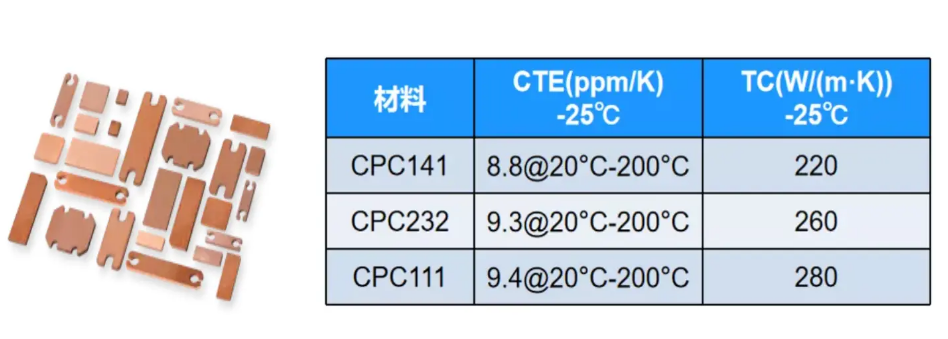
Similar to CMC, CPC is a three-layer composite material featuring copper on the top and bottom surfaces, with a molybdenum-copper (Mo-Cu) alloy layer in the middle. This configuration significantly enhances the material’s thermal conductivity. Like CMC, CPC is produced using the same fabrication methods, requiring a strong bond between the layers and uniform thickness for each layer.
III. Development of Research on Heat Sink Materials for Microelectronic Packaging
As the level of digitalization continues to rise, the complexity of electronic components has increased, leading to more stringent performance requirements for heat sink materials used in microelectronic packaging. In fact, the inception and development of heat sink materials for microelectronic packaging in my country have paralleled those in Western developed nations. In recent years, my country has achieved significant breakthroughs in this field. Given that these materials are fundamental to the operation of high-power electronic components, there is a high demand both domestically and internationally. my country has successfully developed high-end heat sink materials for microelectronic packaging, with technology that now ranks among the best globally. The advancement of tungsten- and molybdenum-based heat sink materials has further propelled the overall progress of my country’s packaging heat sink materials. It is expected that in the near future, my country’s research in this area will reach a world-leading position, characterized by exceptional core competitiveness on the international stage.
IV. Conclusion
Research into heat sink materials for microelectronic packaging enables an increase in the power capacity of electronic components, driving high demand both at home and abroad. Through the persistent efforts of Chinese researchers, significant progress has been made in this field; this has effectively broken the international market monopoly on such materials and strengthened the core competitiveness of my country’s microelectronic packaging heat sink materials in the global market.
Post time: Nov-02-2026