

Tungsten-copper alloy CuW55 combines the high melting point of tungsten with the high conductivity of copper, making it an ideal choice for EDM and resistance welding electrodes. It also boasts advantages in wear resistance and heat dissipation, with performance far exceeding that of pure copper or pure tungsten.
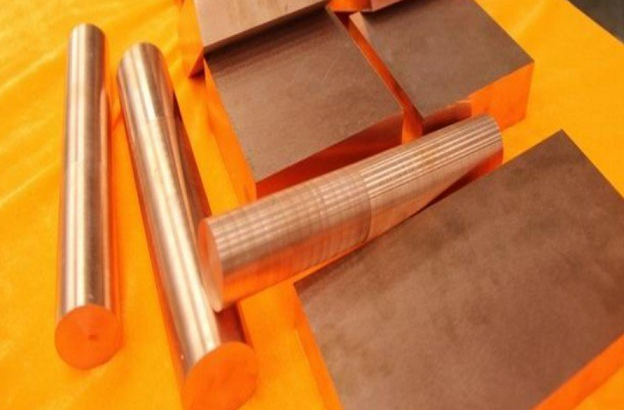
Tungsten-copper alloy electrical materials are a class of functional materials composed of tungsten and copper through powder metallurgy. They combine the high melting point and hardness of tungsten with the high electrical and thermal conductivity of copper, and are widely used in electronics, electrical engineering, and machining. Among them, CuW55 tungsten-copper alloy, with its moderate copper content (approximately 10%-55%), achieves a balance between conductivity, wear resistance, and thermal stability, making it a common choice for EDM and resistance welding electrodes.
I. Technical Principles and Core Components: Tungsten-copper alloys are typically prepared using powder metallurgy: tungsten powder and copper powder are mixed in a specific ratio, then pressed and sintered to form a dense material. CuW55 contains approximately 55% tungsten and 10% copper, with impurities below 0.0001% and a particle size as fine as 0.001 mm, ensuring material uniformity. The tungsten framework provides high strength and high-temperature resistance (softening temperature meets standard values), while the copper phase fills the gaps, imparting electrical conductivity (49 IACS%) and thermal conductivity, while reducing overall density (12.3 g/cm³).
II. Typical Applications:
1. Electrical Discharge Machining (EDM) Electrodes: The high melting point (approximately 3400℃) and resistance to electrolytic corrosion of tungsten-copper alloys make them ideal electrodes for machining materials such as cemented carbide and mold steel, reducing electrode wear and improving machining accuracy.
2. Resistance Welding Electrodes: Used in automotive manufacturing for welding high-strength steel plates. The copper phase ensures conductivity, while the tungsten phase enhances wear resistance and extends electrode life.
3. Heat Dissipation Components: High thermal conductivity (approximately 200 W/m·K) makes it suitable for electronic packaging substrates, aiding in rapid chip heat dissipation. 4. High-voltage switch contacts: Tungsten’s resistance to arc erosion prevents contact welding, ensuring stable operation of the power system.
III. Technical Parameters and Performance Advantages: CuW55 has a hardness of 125HB, combining strength and toughness, and can withstand mechanical impact; particle size control ensures material density, reducing the risk of processing cracks; standard packaging and transportation methods (such as moisture-proof sealing) ensure the stability of the material during storage and distribution. Its performance advantages are reflected in: more than 3 times the high-temperature resistance compared to pure copper electrodes; and 50% higher conductivity compared to pure tungsten materials, making it more suitable for high-frequency current scenarios.
IV. Precautions for Use:
1. Select appropriate cutting tools according to the material hardness during processing to avoid over-cutting that may cause cracking.
2. Clean the surface before welding or EDM to prevent impurities from affecting conductivity.
3. The storage environment should be dry and protected from light to prevent copper phase oxidation that may lead to performance degradation.
4. If the surface wears down after long-term use, it can be restored to smoothness through grinding, but the thickness must be controlled to avoid affecting conductivity.
Post time: Feb-25-2026