

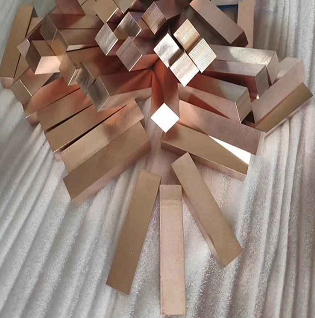
CuW80 tungsten-copper alloy is a composite material featuring a two-phase structure composed of tungsten (W) and copper (Cu); it is widely used in industrial sectors due to its excellent physical and mechanical properties. This alloy offers high density and good electrical and thermal conductivity, alongside favorable high-temperature strength and a degree of ductility. As the heat treatment process plays a decisive role in the final performance of CuW80 alloy, understanding and mastering the correct heat treatment procedures is crucial.
Importance of Heat Treatment Processes
Heat treatment can significantly enhance the mechanical properties and wear resistance of CuW80 alloy, thereby extending its service life and improving reliability. Through heat treatment, the alloy’s microstructure can be optimized; this process reduces or eliminates work hardening and improves ductility and toughness, while simultaneously boosting strength and hardness via mechanisms such as precipitation hardening and solution treatment.
Overview of Heat Treatment Processes
The heat treatment process for CuW80 tungsten-copper alloy generally involves the following steps:
Melting:
Tungsten, copper, and other additives are charged into a melting furnace in specific proportions and melted at high temperatures to form a homogeneous alloy melt.
Forging:
The molten alloy undergoes forging to improve material density and homogeneity. During forging, internal grains are refined, which helps enhance the material’s mechanical properties.
Sintering:
Sintering is a critical step in the production of CuW80 alloy, typically employing techniques such as liquid-phase sintering or activated sintering. During this process, the copper phase interacts with the tungsten particles to form a uniform two-phase structure.
Heat Treatment:
Heat treatment encompasses processes such as solution treatment, aging treatment, and annealing. Solution treatment increases the solubility of tungsten within the copper matrix, thereby enhancing the alloy’s strength and hardness; aging treatment promotes the growth of fine precipitates, further improving mechanical properties; and annealing is primarily used to relieve stresses induced during forging and sintering, thereby enhancing the material’s ductility and toughness.
Cooling:
Following heat treatment, the alloy requires appropriate cooling to maintain microstructural stability. Rapid cooling (such as water quenching) prevents the coarsening of precipitates, whereas slow cooling facilitates the homogenization of the alloy’s internal microstructure.
Optimization of Heat Treatment Processes
To achieve optimal performance, the heat treatment process for CuW80 tungsten-copper alloy must be tailored to specific application requirements. For instance, thermal conductivity can be optimized by adjusting heat treatment parameters for applications requiring efficient heat transfer, while wear resistance can be enhanced by increasing the alloy’s hardness and strength for applications subject to high wear.
Conclusion
The heat treatment process significantly influences the performance of CuW80 tungsten-copper alloy. Proper heat treatment can markedly improve the alloy’s mechanical properties, wear resistance, and electrical and thermal conductivity, meeting the demands of diverse industrial applications. Future research should focus on developing novel heat treatment techniques and further optimizing existing processes to maximize the performance of CuW80 tungsten-copper alloy.
Post time: Oct-02-2026